Ankle Ligament Damage: What It Is, How Bad It Is, and How to Fix It Properly
By City Physio & Pilates | 25 Martin Place, Sydney CBD
Rolled your ankle? Here’s the thing – how you manage the next few weeks determines whether this becomes a one-off inconvenience or a recurring problem that follows you for years. Get it right from the start.
The Ankle Sprain Nobody Takes Seriously (Until They Should Have)
Ankle sprains are one of the most common injuries we see at City Physio in Martin Place – and one of the most mismanaged. Not because people are doing the wrong things intentionally, but because the two most common responses are exactly wrong: either walking it off and hoping for the best, or resting it completely and waiting for something to happen.
Neither approach addresses what actually needs to happen for a ligament injury to heal properly, restore full function, and not happen again six weeks later.
We’ve assessed and rehabilitated thousands of ankle injuries – in Sydney CBD professionals who went over on uneven footpath, in netballers and footballers mid-season, in runners mid-block, and yes, in ourselves. Ankle ligament damage across the severity spectrum is something we know extremely well. And the one consistent truth is this: a thorough assessment on day one, followed by a structured rehab plan, produces dramatically better outcomes than anything else.
Here’s what you need to know.
What’s Actually Damaged in an Ankle Sprain?
TL;DR: We have to assess it, first!
The ankle is stabilised by several key ligament groups that prevent excessive movement, particularly during walking, running, jumping, and pivoting. When the ankle rolls inward (the classic inversion mechanism… stepping off a kerb wrong, landing awkwardly, going over on uneven ground), the ligaments on the outside of the ankle take the load.
The three lateral ligaments (the ones on the outside of the ankle) most commonly injured are:
- Anterior talofibular ligament (ATFL) — the most frequently damaged, runs from the fibula to the front of the talus
- Calcaneofibular ligament (CFL) — runs from the fibula to the heel bone, injured in more severe sprains
- Posterior talofibular ligament (PTFL) — the strongest of the three, only significantly injured in severe trauma
Ankle sprains are graded based on the degree of ligament involvement:
| Grade | What’s happened | What it feels like |
|---|---|---|
| Grade I | Ligament fibres stretched, no tearing | Mild pain and swelling, weight-bearing manageable |
| Grade II | Partial ligament tear | Moderate swelling and bruising, reduced stability, painful weight-bearing |
| Grade III | Complete rupture of one or more ligaments | Significant swelling, instability, weight-bearing very painful or not possible |
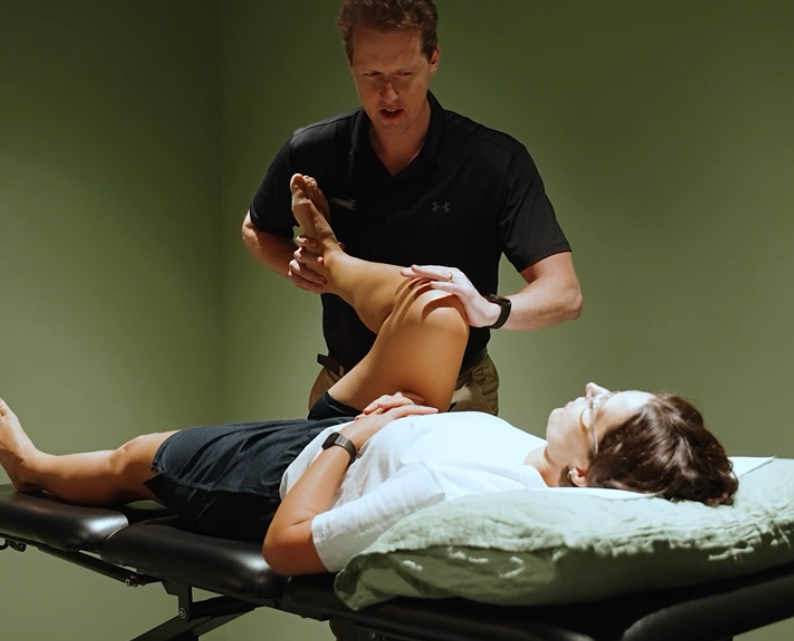
Distinguishing between these grades matters – not just for prognosis, but because the rehabilitation approach, timeline, and whether imaging or specialist referral is indicated differs substantially between them. This isn’t something a Google search or a friend’s opinion can reliably determine. It requires experienced hands-on assessment with specific clinical tests that have high sensitivity for ligament integrity. And even better- the more you have assessed the more accurate your assessment is! And luckily for you, we’ve assessed A LOT of ankles!!
That’s exactly what you get at City Physio on your first appointment.
We will assess it, grade it and tell you the plan. And if we cant, or we’re not sure, we may refer you on for a scan that can tell us exactly!
It Might Not Just Be a Sprain – Other Causes of Ankle Pain Worth Ruling Out
Ankle pain after a roll or a trauma isn’t always a straightforward lateral ligament sprain. An accurate diagnosis requires ruling out several other conditions that present similarly but need different management:
Syndesmosis injury (high ankle sprain) Injury to the ligaments connecting the tibia and fibula above the ankle joint. More common than people think, significantly undertreated, and carries a much longer recovery timeline than a standard lateral sprain if not properly identified.
Fractures The Ottawa Ankle Rules – a validated clinical tool – guide assessment of fracture risk. If weight-bearing is not possible or there’s bony tenderness in specific locations, imaging is warranted. Our physiotherapists are trained in these assessment protocols and will refer for X-ray or MRI where clinically indicated.
Tendon pathology Peroneal tendinopathy, Achilles tendinopathy, and flexor hallucis longus issues can all be provoked by a traumatic ankle injury or present alongside one. Missing these means treating the wrong structure.
Joint impingement Anterior or posterior ankle impingement – bony or soft tissue – can cause persistent pain and restricted movement after an ankle injury, and requires different management to ligament rehabilitation.
Referred pain Less common but worth flagging: ankle and foot pain can be referred from the knee, hip, or lumbar spine. A comprehensive biomechanical assessment picks this up early.
Getting the diagnosis right isn’t a formality – it’s the foundation of everything that comes next.
Why “Walking It Off” or “Resting It” Both Miss the Point
The ankle is a joint that depends on active neuromuscular control as much as passive structural integrity. The ligaments don’t just hold the joint together – they’re packed with proprioceptive nerve endings that constantly feed information about position and load to your nervous system. When those fibres are damaged, proprioception is disrupted. And proprioceptive deficits are the primary reason ankle sprains recur.
Walking it off doesn’t allow the acute inflammatory process to regulate, risks ongoing mechanical stress on damaged tissue, and does nothing to address the neuromuscular deficits.
Complete rest allows swelling to persist, leads to stiffness, and delays the reloading process that drives ligament healing and neuromuscular recovery. Ligaments heal in response to progressive mechanical load – not immobilisation.
What’s actually required is a graded, progressive rehabilitation program that matches the right loads and movements to the right stage of healing. That requires clinical expertise, not guesswork.
What a Comprehensive Ankle Assessment at City Physio Includes
On your first appointment, our physiotherapists will assess:
Structural integrity Specific clinical tests – including the anterior drawer test and talar tilt test – to assess ATFL and CFL integrity and determine injury grade with high diagnostic accuracy.
Swelling and tissue response Volume and distribution of swelling, bruising pattern, and palpation of key structures to identify all injured tissues.
Range of motion Ankle dorsiflexion, plantar flexion, inversion and eversion – both actively and passively – compared to the uninjured side.
Joint stability and proprioception Single-leg balance and dynamic stability testing to quantify neuromuscular deficit and guide the rehabilitation starting point.
Walking and running mechanics How your ankle is loading during function – particularly important for athletes and CBD professionals who need to be on their feet.
Imaging and referral decisions We’ll advise clearly on whether X-ray or MRI is warranted, and refer to an orthopaedic surgeon where Grade III injuries or other pathology indicate this may be the more appropriate management pathway. In most cases, physiotherapy is the right first-line treatment – and we’ll tell you that honestly on day one, along with a realistic prognosis and a clear plan.
The Rehabilitation Pathway: What Recovery Actually Looks Like
Ankle ligament rehabilitation is not one-size-fits-all. The program we design for a netballer returning to competition looks different from the one we design for a CBD professional who needs to walk to Martin Place Station comfortably. Both are important. Both get the same level of clinical attention.
Stage 1 — Acute Management (Days 1–7) Structured load management, swelling control, early pain-free movement to prevent stiffness, and protection of the healing tissue. We’ll give you a clear protocol, not just “RICE and rest.”
Stage 2 — Restore Range and Basic Stability (Week 1–3) Progressive restoration of ankle range of motion, early proprioceptive training in controlled positions, and beginning to build strength in the peroneal muscles, the primary dynamic stabilisers of the lateral ankle.
Stage 3 — Strength and Neuromuscular Control (Week 3–8) Progressive single-leg strengthening, balance and proprioception training on increasingly challenging surfaces, and calf and lower limb loading. For athletes, this includes sport-specific movement patterns.
Stage 4 — Return to Full Activity (Week 6 onwards, grade-dependent) Running reintroduction, change-of-direction training, plyometric loading, and sport-specific return-to-play criteria. For non-athletes, this means confident walking on uneven surfaces, stairs, and returning to your normal movement demands without hesitation or compensation.
What Happens If You Don’t Rehabilitate Properly
We’re not going to catastrophise – most ankle sprains, even when initially undertreated, don’t lead to the worst outcomes. But the risk of inadequate rehabilitation is real and well-documented:
Chronic ankle instability… recurrent rolling of the ankle due to unresolved proprioceptive deficits and weakened lateral stabilisers. This is the most common long-term consequence of undertreated ankle sprains, and it’s largely avoidable with appropriate early rehab.
Persistent pain and stiffness, particularly from undiagnosed associated injuries (syndesmosis, cartilage, tendon) that were missed at initial assessment.
Compensatory loading patterns – ankle pain that changes how you walk and run, which progressively loads the knee, hip, and lower back in ways they’re not designed for.
Reduced performance… athletes and active people who return to sport before achieving full neuromuscular control are at substantially elevated re-injury risk.
An experienced physiotherapist tells you all of this at appointment one – clearly, honestly, and with a plan that addresses it.
Ankle Physiotherapy at City Physio, Martin Place – Sydney CBD
We treat ankle ligament injuries – from Grade I sprains to complete ruptures (and sometimes with a nice little fracture in there, too!) at our clinic at 25 Martin Place, in the heart of Sydney’s CBD. Our physiotherapists have extensive experience assessing and rehabilitating ankle injuries in athletes across a wide range of sports, as well as in CBD professionals and everyday active people.
Our approach is thorough from the first appointment: accurate diagnosis, honest prognosis, and a rehabilitation plan tailored specifically to your injury grade, your lifestyle, and your goals. We don’t do generic protocols. We don’t just give you a theraband and a sheet.
We also have an integrated Pilates studio on-site – useful for the strength and neuromuscular retraining phases of ankle rehabilitation, particularly for patients managing concurrent lower limb or postural issues.
Book an Ankle Assessment at City Physio
If you’ve rolled your ankle, whether yesterday or six months ago and it still doesn’t feel right – get it properly assessed. Early intervention produces better outcomes. Persistent instability that’s been left too long is harder to treat but still very much manageable.
📍 City Physio & Pilates Shop 10, Level 6, 25 Martin Place, Sydney CBD NSW 2000 (Rear of the food court – follow the signs)
📞 (02) 9223 1575 ✉️ hello@cityphysio.com.au 🌐 cityphysio.com.au
Monday – Friday | 7:00am – 6:00pm
Rolled ankles don’t fix themselves. But they do respond very well to people who know what they’re doing.