City Physio & Pilates | Expert Insights | Neck & Back Pain
The Business Lunch Neck
Why CBD professionals develop a specific, recognisable pattern of cervical dysfunction… and why “just stretch it” is not the answer.
The pattern is consistent enough that we could draw it from memory before the patient sits down.
They work in finance, law, consulting, or medicine. They are at their desk by eight and rarely leave before six. Lunch, when it happens, is either eaten in front of a screen or conducted across a restaurant table in a posture that is, frankly, not meaningfully different from the one they left. They travel for work. They sleep poorly when deadlines are close. They have been meaning to do something about their neck for somewhere between six months and four years.
The neck itself presents with a predictable combination: restricted rotation, usually worse to one side. Upper cervical stiffness that produces a dull, persistent ache across the base of the skull. Episodic headaches that start at the occiput and migrate forward. Occasional referral into the shoulder or upper arm. A levator scapulae that could deflect a cricket ball. And the unshakeable conviction that if they could just find the right stretch, or the right pillow, or the right massage therapist, it would eventually sort itself out.
It will not sort itself out. Not without addressing what’s actually driving it.
Why the CBD professional neck is its own clinical entity
Neck pain is common across the working population. But the specific loading profile of high-performing knowledge workers in the Sydney CBD produces a pattern of cervical dysfunction that is worth understanding in some detail, because the contributing factors are multiple, layered, and not all of them are the ones patients expect.
The sustained flexion load
The average knowledge worker spends somewhere between six and ten hours per day with their cervical spine in a position of forward head posture and mild flexion. For every centimetre the head translates forward from its neutral position over the shoulders, the effective weight of the head on the cervical spine increases substantially, a mechanism described in the literature as increased cervical compressive load under forward head translation.
The practical effect is that the posterior cervical muscles, the suboccipitals, semispinalis, and cervical erectors are working under sustained eccentric load for most of the working day. Over time, they develop the characteristic combination of hypertonicity and reduced endurance that produces the ache, the stiffness, and the difficulty sustaining even comfortable postures for any length of time.
The meeting posture problem
Desk posture gets most of the attention. Meeting posture gets almost none. And yet the CBD professional spends a significant portion of their day in meeting rooms, across boardroom tables, or on video calls, all of which involve a different but equally problematic cervical loading pattern.
The sustained rotation of a long lunch conversation. The chin-forward lean toward a conference room screen. The slight cervical side-flexion of a phone held between ear and shoulder during a call that was supposed to be five minutes. These positions load the cervical facet joints asymmetrically and repeatedly, producing the joint irritation and muscle guarding that drives unilateral neck pain and restricted rotation.
The stress-tension amplifier
High-performing professionals operate under sustained cognitive and emotional load that has a direct physiological effect on the cervical spine. Psychological stress upregulates the sympathetic nervous system, increases resting muscle tone, particularly in the upper trapezius, levator scapulae, and posterior cervical muscles, and lowers the threshold at which the nervous system interprets mechanical input as threatening.
In practical terms: the neck that is fine during a quiet week becomes acutely painful in the lead-up to a board presentation or a deal close. The pain is real, the underlying mechanics are real, and the stress is a genuine amplifier — not a sign that the problem is “just stress” and therefore dismissible.
The travel component
Business travel loads the cervical spine in ways that rarely get mentioned. Long-haul flights in business class seats that are not, despite the marketing, particularly well designed for cervical support. Hours in taxis and Ubers with the neck in slight flexion and rotation looking at a phone. Hotel pillows of spectacular inappropriateness. The cumulative cervical load of a week of interstate or international travel for many CBD professionals is substantial — and the pattern of symptoms that follows is predictable.
Why stretching doesn’t fix it
The cervical self-management advice most people receive is some variation of: stretch it, use a heat pack, get a massage, try a different pillow. These strategies share a common limitation, they address the symptomatic muscle tension without touching the underlying joint dysfunction and motor control deficit that’s generating it.
The upper cervical facet joints, when irritated or hypomobile, produce reflexive muscle guarding in the surrounding musculature as a protective response. Stretching the muscles while the joint remains dysfunctional is like pulling on the handbrake cable while the handbrake itself is jammed on. You might get some temporary give. The underlying problem persists.
Deep neck flexor inhibition is the other commonly missed element. The longus colli and longus capitis who are the deep stabilising muscles of the anterior cervical spine, become progressively inhibited in people with chronic neck pain and forward head posture. Their inhibition removes the fine motor control that keeps the upper cervical segments stable under load, which increases the mechanical stress on the posterior structures and perpetuates the cycle. No stretch addresses this. It requires specific, progressive retraining.
What assessment and treatment actually involves
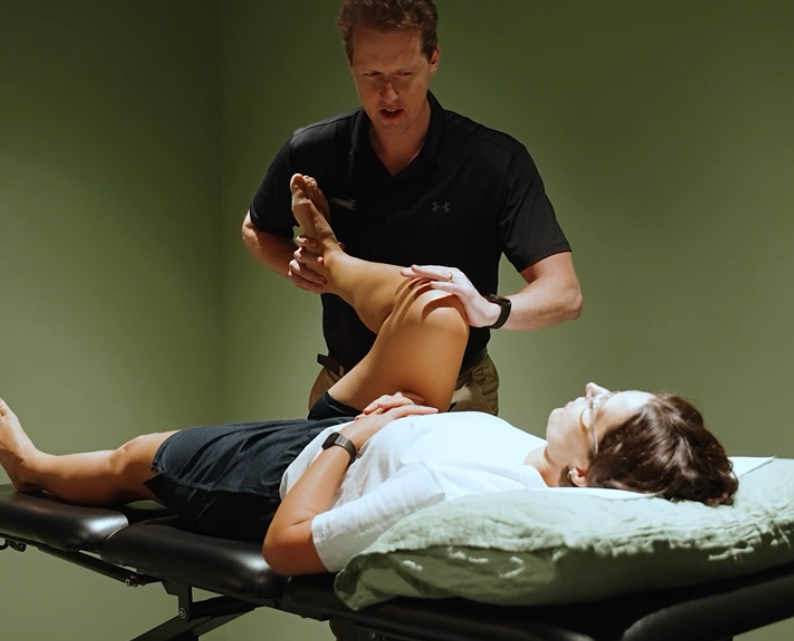
At City Physio & Pilates, cervical assessment goes beyond range of motion and palpation. We examine the specific segmental mobility of the upper, mid, and lower cervical spine; the deep neck flexor recruitment pattern; the relationship between cervical and thoracic mobility; and the neural sensitivity of the structures that refer into the head, shoulder, and arm.
Treatment for the CBD professional neck typically combines:
- Upper cervical joint mobilisation — directed at the specific hypomobile segments driving the restriction and headache pattern
- Deep neck flexor retraining — progressive, specific exercise to restore the active stabilisation that sustained desk work has switched off
- Thoracic mobility — the thoracic spine is the foundation of cervical posture; a stiff thoracic spine forces the cervical spine into the compensatory forward head position that drives the whole pattern
- Soft tissue therapy to the posterior cervical muscles, suboccipitals, and levator scapulae — not as the primary treatment, but as an adjunct that allows the joint and exercise work to be more effective
- Load management advice tailored to a professional schedule — which includes guidance on travel, meetings, and the specific postural habits that are doing the most damage
- Clinical Pilates for cervical and thoracic control in a progressive, structured environment
For most people who present with this pattern, meaningful improvement is achievable within a relatively short course of treatment — provided the underlying drivers are addressed rather than just the symptomatic tension. The four-year history is not a life sentence. It’s just four years of the wrong approach.
Frequently asked questions
Ergonomic setup reduces mechanical load but doesn’t address the underlying motor control deficits — particularly deep neck flexor inhibition — that develop with chronic forward head posture. A well-set-up workstation reduces the rate of loading. It doesn’t restore the active stabilisation capacity of the cervical spine.
Yes, directly. Psychological stress increases resting muscle tone in the upper trapezius and posterior cervical muscles, and lowers the threshold at which the nervous system interprets mechanical input as threatening. Stress amplifies existing cervical dysfunction, which is why neck pain that’s manageable in a quiet week becomes acute in the lead-up to a board presentation.
Long-haul travel loads the cervical spine through sustained flexion, rotation, and inadequate support over hours. Combined with dehydration, disrupted sleep, and sympathetic nervous system activation, the cumulative load on the cervical joints is significant. Symptoms often emerge one to three days after travel rather than immediately… which is why people don’t always connect the two.
Ergonomic setup reduces mechanical load but doesn’t address the underlying motor control deficits — particularly deep neck flexor inhibition — that develop with chronic forward head posture. A well-set-up workstation reduces the rate of loading. It doesn’t restore the active stabilisation capacity of the cervical spine.