City Physio & Pilates | Jaw Pain | Martin Place, Sydney CBD
The Rise of Misdiagnosed TMJ Pain – and Why Getting It Wrong Makes It Worse
More practitioners are treating jaw pain than ever before. That would be good news, if the assessment underpinning that treatment were keeping pace.
Something has shifted in the last few years. Jaw pain; once the exclusive territory of dentists, oral surgeons, and a handful of physiotherapists with a genuine subspecialty interest, has become something of a growth area in physiotherapy practice. Clinics are advertising TMJ treatment. Practitioners are listing orofacial pain as a special interest. Patients who would previously have cycled through dentists and GPs without a useful answer are being directed toward physiotherapy, sometimes appropriately, sometimes not.
I want to be clear: this is largely a good development. TMJ dysfunction is underdiagnosed, undermanaged, and underserved by most of the healthcare system. More physiotherapists engaging with it is a net positive.
But there’s a problem. In the clinic, I am seeing a rising number of patients who have already been treated by another physiotherapist for their jaw pain… and who have not improved, or have gotten worse. When I take the history and examine these patients, a pattern has emerged that is worth naming directly, because understanding it is the difference between treatment that helps and treatment that doesn’t.
A special interest is not a speciality
There is a meaningful clinical difference between a physiotherapist who has a special interest in jaw pain and one who has developed genuine subspecialty competence in orofacial pain and TMJ biomechanics. The former typically means the practitioner has completed a short course, attended a weekend workshop, or simply treated enough jaw patients to feel comfortable with the presentation. The latter involves years of clinical immersion, advanced study, and – critically – a deep understanding of the mechanics of a joint that behaves unlike almost any other joint in the body.
The TMJ is a biarthrodial joint. This is not a piece of trivia, it is the foundational anatomical fact that determines how the joint must be assessed and treated, and it is the fact most commonly missing from the clinical reasoning of practitioners who venture into this space without adequate preparation.
What biarthrodial actually means – and why it matters
The temporomandibular joint is unique in that it functions as two distinct joints in one: the inferior joint space, between the condyle of the mandible and the articular disc, and the superior joint space, between the disc and the mandibular fossa of the temporal bone. These two compartments have different movements, different mechanical functions, and different clinical implications when they go wrong.
Normal jaw opening involves a precise, two-phase mechanical sequence. In the first phase, rotation, the condyle rotates within the mandibular fossa. This accounts for approximately the first 25 millimetres of mouth opening. In the second phase, translation, the condyle and disc complex glide anteriorly down the articular eminence, allowing the full range of jaw opening beyond that initial rotational phase.
Rotation first. Translation second. In that order. That sequence is not optional… it is the biomechanical design of the joint.
When a condyle fails to rotate adequately within the fossa before translation begins, when it translates too early, before the rotational component has been completed- the disc mechanics become abnormal. The condyle loads the posterior disc attachment rather than the central disc, the disc-condyle relationship becomes disrupted, and the joint produces exactly the click, the pain, the restricted opening, and the deviation on movement that brings patients into physiotherapy in the first place.
The symptomatic side is not always the dysfunctional side
This is the clinical point that generates the most mismanagement, and it deserves plain language.
A patient presents with pain on the left side of the jaw. The left masseter is tender. The left lateral pterygoid aches on palpation. The left TMJ clicks on opening. The treating clinician focuses treatment on the left side, soft tissue release, massage of the masticatory muscles, mobilisation of the left joint. The patient feels temporarily better, returns the following week with the same or worsening symptoms, and the cycle continues.
What has not been assessed: the opening mechanics of the right TMJ. Because when you watch this patient open their mouth carefully, really watch the condylar path, the disc behaviour, the symmetry of the mandibular arc, what you often see is a right condyle that isn’t rotating. It’s translating immediately, loading the posterior disc attachment, pulling the mandible to the right before it swings back to the left. The left-sided muscles are working overtime to drag the jaw back to midline on every opening cycle. They’re painful because they’re doing too much work. They’re doing too much work because the right joint is failing mechanically.
Massaging the left masseter in this scenario… firmly, repeatedly, therapeutically… releases the one structure that is holding the system together. The left-sided muscles are the symptom. The right-sided mechanics are the cause.
Why firm soft tissue release on the wrong side makes things worse
The masticatory muscles, masseter, temporalis, medial and lateral pterygoids, are not simply tense because someone is stressed or clenching. In a patient with unilateral condylar translation dysfunction, they are hypertonic because the neuromuscular system has recruited them to compensate for a mechanical deficit. This is protective hypertonicity. The muscles are doing a specific job.
Hard massage to a muscle in protective hypertonicity does several things, none of them helpful in this context. It temporarily reduces tone, which removes the compensation. It increases local circulation and tissue extensibility… which feels good for approximately twelve to twenty-four hours. It does not address the joint mechanics that necessitated the compensation in the first place. And so the muscles return to exactly the same state, because the problem that created the state hasn’t changed.
Repeated firm massage of the symptomatic masticatory muscles in a patient with contralateral condylar dysfunction is not a neutral intervention. It sensitises the soft tissues over time. It trains the patient to associate jaw treatment with temporary relief followed by relapse, which erodes confidence in any treatment. And in some cases, it destabilises the one muscular pattern that was keeping the patient’s symptoms from being significantly worse.
What a proper TMJ assessment actually involves
Assessment of the temporomandibular joint, as I practise it, begins before the patient opens their mouth. The cervical spine is examined first; the upper cervical joints share neural territory with the TMJ, and cervical dysfunction is a contributing factor in a significant proportion of chronic TMD presentations. A jaw treated in isolation from the neck is rarely a jaw treated completely.
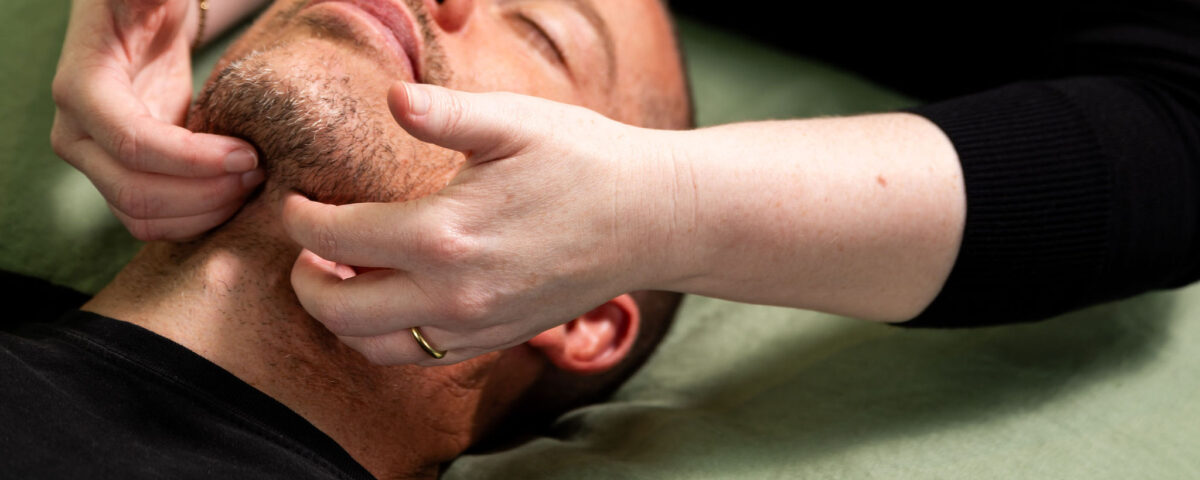
The assessment then moves to the jaw itself, but bilaterally, from the first moment. Both condyles are palpated simultaneously during opening and closing. The arc of movement is observed for deviation, deflection, and the point at which each condyle transitions from rotation to translation. Clicking is assessed for its timing, its direction, and whether it is a disc displacement with or without reduction… or whether its something else entirely! The muscles of mastication are assessed on both sides, in that context, not as primary drivers, but as responders to what the joints are doing.
The question the assessment is trying to answer is not “which side hurts?” It’s “which joint is failing to rotate, and what is the consequence of that failure for the rest of the system?”
Treatment follows from that answer. When the dysfunctional side is correctly identified, specific joint mobilisation to restore rotational mechanics, combined with motor retraining of the opening pattern, addresses the actual problem. The contralateral muscles, freed from their compensatory role, often settle without being directly treated at all. We then stabilise the jaw within the whole system- breathing, sitting, eating, clenching.
Who should be treating jaw pain
I am not arguing that only orofacial pain specialists should treat TMJ dysfunction. We have both in our clinic! Mild, straightforward TMD presentations, a single disc displacement with reduction, bruxism-related muscle pain without significant mechanical dysfunction, are within the competence of any physiotherapist who has done adequate training in this area. We see this regularly and I often triage my patients down to a more appropriate clinician within the clinic (my diary can be crazy, I’m sure you’ve seen!).
What I am arguing is that chronic, treatment-resistant, or bilateral TMJ presentations require assessment and management by someone who understands the biarthrodial mechanics of the joint well enough to distinguish the symptomatic side from the dysfunctional side. That distinction is not taught in a weekend course. It comes from a clinical education in orofacial pain, from supervised practice, and from treating enough complex cases to have seen the pattern fail, and to understand why.
If you’ve been treated for jaw pain and haven’t improved, or if your symptoms have worsened after treatment, the question worth asking is whether both sides of your jaw were assessed… not just the one that hurts.
Frequently asked questions
The TMJ is biarthrodial- it functions as two joints in one. The inferior compartment handles rotation between the condyle and articular disc. The superior compartment handles translation between the disc and the mandibular fossa. Normal jaw opening requires rotation first, then translation. When that sequence breaks down, disc mechanics become abnormal and pain follows, often on the side that’s compensating, not the side that’s failing.
If one condyle fails to rotate and translates too early, the muscles on the opposite side compensate by working harder to keep the jaw aligned during opening. Those muscles become painful through overload, not because they’re the primary problem. Releasing them without addressing the mechanical failure on the other side removes the compensation without fixing the cause.
Yes, if the assessment is incomplete. Repeated firm massage to symptomatic masticatory muscles in a patient with contralateral condylar dysfunction can sensitise soft tissues and destabilise the compensatory patterns that are limiting symptoms. Treatment directed at the correct joint, based on a bilateral assessment, does not carry this risk.
During jaw opening the condyle first rotates within the fossa, then translates anteriorly down the articular eminence. When translation happens too early- before rotation is complete- the posterior disc attachment is loaded abnormally. This is the mechanical origin of the click, the pain, and the deviation on opening that characterises many TMD presentations.
Related: Back Pain | Neck Pain| Shoulder Pain| Manual Therapy