City Physio & Pilates | Expert Insights | Vestibular Physio
Dizziness, Vertigo, and BPPV: They’re Not the Same Thing… and the Difference Matters
The room spinning when you roll over in bed is not the same as feeling lightheaded on the train. A proper vestibular assessment tells them apart — and for the most common cause of true vertigo, a single session is often all it takes.
It starts when you roll over in bed. Or when you tip your head back to look at something on a high shelf. Or when you sit up too quickly after lying down. The world tilts, or spins, or seems briefly and deeply wrong, and then, after ten or twenty or sixty seconds, it passes.
You mention it to your GP. They say it might be an inner ear thing, possibly a virus, possibly stress, possibly blood pressure. They refer you to an ENT. The ENT finds nothing structurally wrong. You’re told to wait and see. It happens again three weeks later.
This is one of the most common and most poorly managed presentations in general practice, not because it’s difficult to treat, but because “dizziness” is one of the most overloaded words in medicine, used interchangeably to describe at least four distinct phenomena that have different causes, different clinical features, and critically, different treatment approaches.
A dedicated vestibular physiotherapy assessment distinguishes them in a single session. For the most common cause of true vertigo, the treatment takes less time than the assessment.
The language problem: what people mean when they say dizzy
Before any useful clinical assessment can happen, the clinician needs to understand what the patient actually experienced. “Dizziness” is the patient’s word. The clinician’s job is to find out which of the following they mean:
- Vertigo — a false sense of rotational movement, either of the self or the environment. The room spins, or you feel like you are spinning within a stationary room. This is a specific symptom with a specific set of causes, and it is not the same as dizziness.
- Presyncope — the lightheaded, swimmy feeling that precedes a faint. Associated with reduced cerebral perfusion — orthostatic hypotension, cardiac arrhythmia, dehydration, vasovagal response. This is not a vestibular problem.
- Disequilibrium — impaired balance and spatial orientation without a rotational sensation. Often described as unsteadiness, walking on a boat, or difficulty with coordination. Can have vestibular, cerebellar, or proprioceptive origins.
- Non-specific dizziness — a floating, foggy, or dissociated sensation that doesn’t fit neatly into the above categories. Often associated with anxiety, migraine, or persistent postural perceptual dizziness (PPPD).
The clinical pathway from this point diverges completely depending on which of these the patient is describing. Treating presyncope as BPPV, or BPPV as cervicogenic dizziness, produces predictably poor results.
The three most common vestibular presentations in physiotherapy practice
BPPV
- Brief episodes, under 60 seconds
- Triggered by head position change
- Rolling over in bed, lying down, looking up
- True rotational vertigo
- Resolves quickly but recurs
- No hearing loss or tinnitus
Cervicogenic dizziness
- Dizziness linked to neck movement or posture
- Associated neck pain or stiffness
- Worse after sustained desk posture
- Unsteadiness rather than spinning
- Often follows whiplash or neck injury
- No nystagmus on Dix-Hallpike
Vestibular neuritis / labyrinthitis
- Sudden onset, severe, prolonged
- Often follows viral illness
- Nausea and vomiting common
- Constant rather than episodic
- Hearing loss in labyrinthitis
- Requires vestibular rehabilitation
BPPV: the most common and most treatable cause of true vertigo
Benign Paroxysmal Positional Vertigo is the most common vestibular disorder seen in physiotherapy practice, accounting for the majority of true vertigo presentations. It is also, when correctly diagnosed, one of the most satisfying conditions to treat, because the mechanism is specific, the test is definitive, and the treatment is often immediately effective.
What causes BPPV
The inner ear contains the vestibular apparatus, which includes three semicircular canals filled with fluid (endolymph) and a structure called the utricle, which contains small calcium carbonate crystals called otoconia (commonly referred to as ear crystals or ear rocks). These crystals sit on a membrane in the utricle and help the brain interpret linear acceleration and head position relative to gravity.
In BPPV, otoconia become dislodged from the utricle and migrate into one of the semicircular canals. When the head moves into certain positions, the displaced crystals create abnormal fluid movement within the canal, sending a false rotational signal to the brain. The brain receives conflicting information, the eyes and other senses say stationary; the inner ear says rotating, and the result is a brief, intense episode of vertigo, often accompanied by rapid involuntary eye movement called nystagmus.
BPPV most commonly affects the posterior semicircular canal (approximately 85 to 90 percent of cases), with the horizontal and anterior canals accounting for the remainder. This distinction matters for treatment, as the repositioning manoeuvre used differs by canal.
Diagnosing BPPV: the Dix-Hallpike test
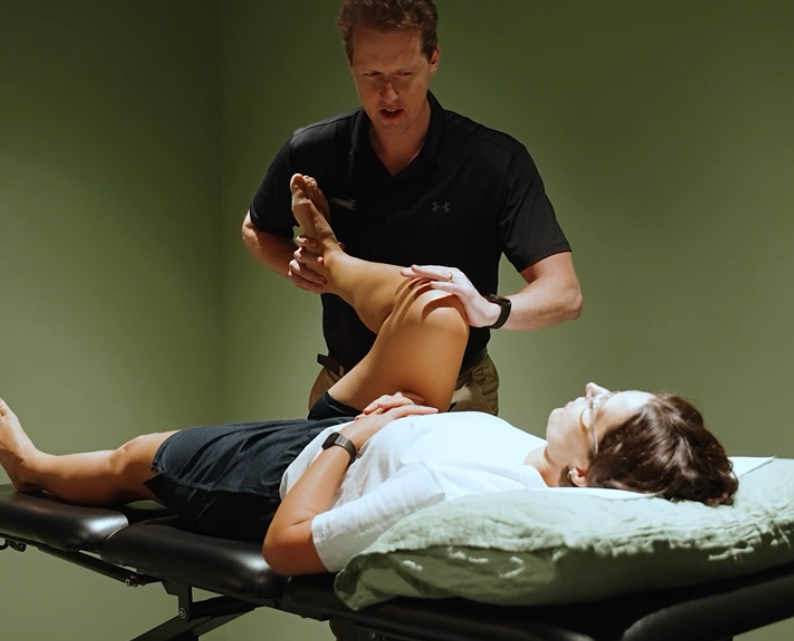
The gold standard diagnostic test for posterior canal BPPV is the Dix-Hallpike manoeuvre. The patient is moved from sitting to lying with their head rotated toward the affected side and extended over the edge of the plinth. In a positive test, this position provokes a characteristic burst of rotational nystagmus, typically upbeat and torsional, with a brief latency and duration under sixty seconds, followed by resolution and reversal on returning to sitting.
The nystagmus pattern is diagnostic. An experienced clinician can identify the affected canal and confirm the diagnosis in under two minutes.
Treating BPPV: the Epley manoeuvre
The Epley manoeuvre is a canalith repositioning procedure that guides the displaced otoconia out of the semicircular canal and back into the utricle through a sequence of head and body positions. It is non-invasive, takes approximately five minutes to perform, and has a resolution rate of around 80 percent after a single treatment in uncomplicated posterior canal BPPV.
For horizontal canal BPPV, the Barbecue roll (log roll) manoeuvre is used instead. For anterior canal BPPV, the least common variant, different repositioning protocols apply.
Many patients who have been managing recurring vertigo for months or years, bouncing between GPs, ENTs, and neurologists, have their BPPV resolved in a single physiotherapy session. It is not unusual for a patient to walk out of their first appointment symptom-free.
Cervicogenic dizziness: when the neck is the source
Cervicogenic dizziness is a diagnosis that generates more clinical debate than almost any other vestibular presentation, partly because the mechanism is incompletely understood, and partly because it requires excluding all other causes before it can be confidently attributed to the cervical spine.
The proposed mechanism involves disruption of proprioceptive input from the upper cervical spine, particularly the facet joints and surrounding musculature at C1 to C3, which contributes to the brain’s construction of spatial orientation and balance. When this input is distorted by joint dysfunction, muscle guarding, or soft tissue injury, the result is a sense of unsteadiness, spatial disorientation, or a vague dizziness that is linked to neck movement or posture rather than head position change.
Clinical features that suggest cervicogenic dizziness
- Dizziness that is provoked or worsened by neck movement, particularly rotation or extension, rather than head position relative to gravity
- Associated neck pain, stiffness, or restricted cervical range of motion
- A history of whiplash, cervical trauma, or chronic desk-related neck dysfunction
- Dizziness that is worse after sustained postures, particularly prolonged screen work
- Unsteadiness or spatial disorientation rather than true rotational vertigo
- A negative Dix-Hallpike test (no nystagmus produced)
- Dizziness that is partially or fully reproduced by cervical spine provocation testing
Treatment is directed at the cervical spine: upper cervical joint mobilisation, deep neck flexor retraining, and progressive vestibular-proprioceptive rehabilitation exercises. Resolution is typically slower than BPPV, weeks to months rather than a single session, but the condition is highly responsive to well-directed physiotherapy when correctly diagnosed.
Vestibular rehabilitation: beyond BPPV
For vestibular disorders that don’t resolve with a repositioning manoeuvre, unilateral vestibular hypofunction following neuritis, bilateral vestibular loss, persistent postural perceptual dizziness, or incomplete compensation after an acute vestibular event, a structured program of vestibular rehabilitation is the evidence-based management approach.
Vestibular rehabilitation uses specific gaze stabilisation exercises, habituation exercises, and balance retraining to promote central compensation for the vestibular deficit, essentially training the brain to recalibrate its use of visual, vestibular, and proprioceptive inputs for balance and spatial orientation. It is progressive, individually prescribed, and meaningfully different from generic “balance exercises.”
Dedicated assessment appointments at City Physio & Pilates
Because vestibular and dizziness presentations require a different assessment framework from standard musculoskeletal physiotherapy, we offer dedicated appointment types designed specifically for these presentations.
Frequently asked questions
What is the Epley manoeuvre?
Can physiotherapy treat vertigo?
Yes. BPPV is treated with repositioning manoeuvres. Cervicogenic dizziness is treated with cervical spine physiotherapy. Vestibular neuritis and persistent vestibular dysfunction are managed with vestibular rehabilitation. Which approach applies depends on what’s actually causing the symptoms, which is what the assessment determines.
Dizziness arising from upper cervical spine dysfunction, which disrupts the proprioceptive signals the brain uses for balance and spatial orientation. It’s associated with neck pain and stiffness, worsened by neck movement or sustained postures, and treated with cervical physiotherapy rather than vestibular repositioning.