By Nicola Michell, APA Titled Pain Physiotherapist, Master of Science in Medicine (Chronic Pain), orofacial speciality, Orofacial Myologist
Short answer. Jaw pain that hasn’t improved with treatment might have been treated on the wrong side. The TMJ works as two joints in one, and the side that hurts is often the side compensating for a joint on the other side that isn’t moving properly. A good assessment looks at both jaw joints, and the neck, before anything is treated.
More practitioners are treating jaw pain than ever before. That would be good news, if the assessment behind the treatment were keeping pace.
Something has shifted in the last few years. Jaw pain, once the territory of dentists, oral surgeons and a handful of physios with a deep interest in it, has become something of a growth area in physiotherapy. Clinics are advertising TMJ treatment. Practitioners are listing orofacial pain as a special interest. Patients who would once have cycled between dentists and GPs without a useful answer are being sent to physio, sometimes appropriately, sometimes not.
I want to be clear: this is largely a good thing. TMJ problems are underdiagnosed and undermanaged across most of the health system, and more physios engaging with them is a net positive.
But there’s a problem. In the clinic, I’m seeing more patients who have already been treated by another physio for their jaw pain, and who haven’t improved, or have got worse. When I take the history and examine them, a pattern turns up that’s worth naming, because understanding it might be the difference between treatment that helps and treatment that doesn’t.
A special interest needs the training behind it
A special interest can mean very different things. For some practitioners it means a short course, a weekend workshop, or having seen enough jaw patients to feel comfortable. For others it means years of advanced study and supervised practice in orofacial pain, and a working understanding of the mechanics of a joint that behaves unlike almost any other in the body.
The TMJ is a biarthrodial (also described as ginglymoarthrodial, meaning it both hinges and glides) joint. That isn’t trivia. It’s the anatomical fact that shapes how the joint should be assessed and treated, and in my experience it’s the piece most often missing from the reasoning when jaw pain hasn’t responded.
What biarthrodial actually means, and why it matters
The jaw joint works as two joints in one. The lower joint space sits between the condyle (the rounded end of the jawbone) and the disc. The upper joint space sits between the disc and the socket in the temporal bone. The two compartments move differently, do different jobs, and cause different problems when they go wrong.
Normal opening is a two-phase sequence. First, rotation: the condyle rotates in the socket, which accounts for roughly the first 25 millimetres of opening. Second, translation: the condyle and disc glide forward down the slope of the joint, allowing the rest of the opening.
Rotation first. Translation second. In that order. That sequence isn’t optional. It’s how the joint is built.
When a condyle doesn’t rotate enough before it starts to translate, in other words it translates too early, the disc mechanics can go wrong. The condyle loads the back of the disc attachment rather than the centre of the disc, and you can end up with exactly the click, the pain, the limited opening and the sideways shift that bring people into physio in the first place.
The joint that translates too early is often the one on the opposite side to the pain. The painful side is frequently the side working too hard to make up for the other one. BUT THIS IS NOT THE RULE. Treating the painful side without assessing both joints is incomplete at best, and at worst it might reinforce the problem.
The side that hurts isn’t always the side that’s failing
This is the point that generates the most mismanagement, so here it is in plain language.
Someone comes in with pain on the left side of their jaw. The left masseter is tender. The left lateral pterygoid aches when pressed. The left TMJ clicks on opening. Treatment goes to the left side: soft tissue release, massage of the chewing muscles, mobilisation of the left joint. They feel better for a bit, come back the following week the same or worse, and around it goes.
What hasn’t been looked at is how the right TMJ opens. When you watch this person open their mouth carefully, really watch the path of each condyle, the disc behaviour and the symmetry of the arc, what you often see is a right condyle that isn’t rotating. It translates straight away, loads the back of the disc, and pulls the jaw to the right before it swings back to the left. The left-sided muscles are working overtime to drag the jaw back to the middle on every opening. They’re sore because they’re doing too much. They’re doing too much because the right joint isn’t doing its job.
Firm, repeated massage of the left masseter in this situation releases the one structure holding the system together. The left-sided muscles are the symptom. The right-sided mechanics are the cause.
Why firm massage on the wrong side can make things worse
The chewing muscles (masseter, temporalis, medial and lateral pterygoids) aren’t always tight just because someone is stressed or clenching. When one condyle isn’t moving properly, they might be tight because the nervous system has recruited them to compensate. That’s protective muscle tension, and it’s doing a specific job.
Hard massage to a muscle that’s guarding like this temporarily reduces the tension, which removes the compensation. It also feels good, in my experience for about twelve to twenty-four hours. It doesn’t change the joint mechanics that needed the compensation, so the muscles go straight back to where they were.
Done repeatedly, it isn’t a neutral treatment. It can sensitise the tissues over time. It teaches people to expect jaw treatment to mean a day of relief followed by a relapse, which wears down their confidence in any treatment. And sometimes it destabilises the one muscle pattern that was stopping things from being worse.
What a proper TMJ assessment involves
The way I assess the jaw starts before anyone opens their mouth. I look at the neck first. The upper neck and the jaw share nerve territory, and neck problems turn up alongside chronic jaw pain often enough that a jaw assessed without the neck is rarely assessed completely.
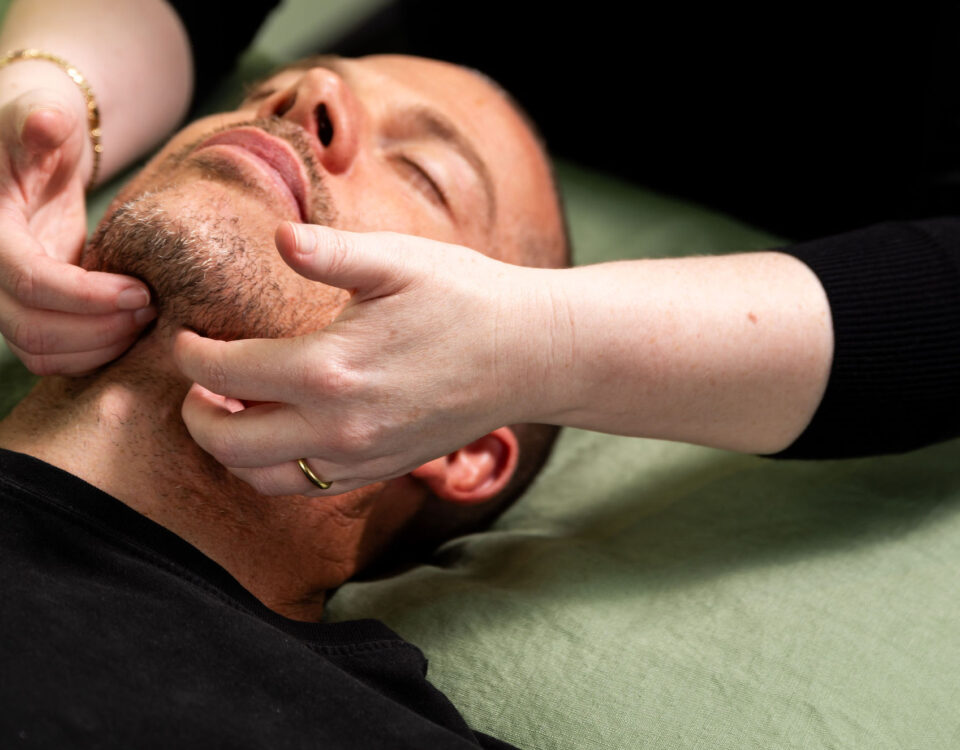
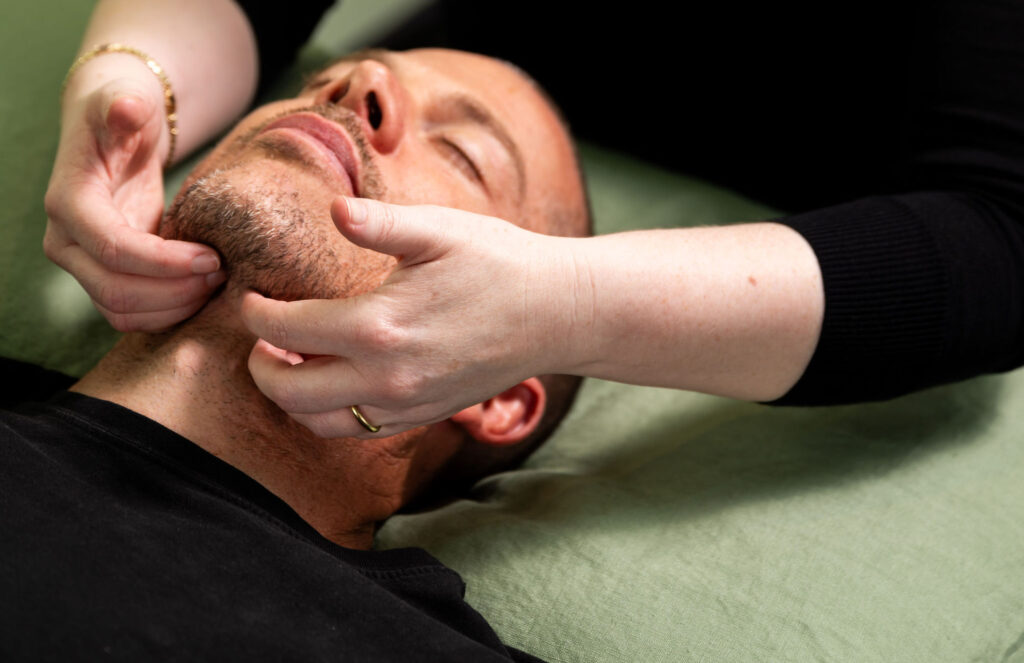
Then the jaw itself, both sides, from the first moment. Both condyles are felt at the same time during opening and closing. I watch the arc of movement for deviation and for the point where each condyle switches from rotation to translation. A click is assessed for its timing, its direction, and whether it’s a disc that’s slipping and returning, one that isn’t returning, or something else entirely. The chewing muscles are checked on both sides in that context, as responders to what the joints are doing rather than the main event.
The question isn’t “which side hurts?” It’s “which joint isn’t rotating properly, and what is that doing to the rest of the system?”
Treatment follows from the answer. Once the side that’s failing is identified, specific joint mobilisation to restore rotation, combined with retraining of the opening pattern, goes after the actual problem. The muscles on the other side, freed from their extra job, often settle once the joint is moving properly. Then we work on the jaw within the whole system: breathing, sitting, eating, clenching.
Who should be treating jaw pain
I’m not arguing that only one kind of clinician should treat TMJ problems. Mild, straightforward presentations, such as a single disc that clicks but returns, or clenching-related muscle pain without much joint dysfunction, are well within the reach of any physio who has done good training in this area.
What I am arguing is that chronic, treatment-resistant or two-sided jaw problems need someone who understands the mechanics well enough to tell the side that hurts from the side that’s failing. That comes from proper training in orofacial pain, supervised practice, and enough complex cases to have seen the pattern fail, and understood why.
My diary is open again. New jaw patients can book a dedicated TMJ appointment with me, Ed Germanos or Matt Hagerty online.
If you’ve been treated for jaw pain and haven’t improved, or you’ve got worse after treatment, the question worth asking is whether both sides of your jaw were assessed, not just the one that hurts.
Get medical help first if
- jaw pain comes with chest pain, or pain spreading into your arm, neck or back: call 000
- jaw symptoms come with double or blurred vision, trouble eating or drinking, or frequent, severe headaches
- your jaw might be dislocated, or the pain followed a strong blow to the face
- the pain came on after an injury to your teeth or mouth (see a dentist)
Related pages
Common questions
What does biarthrodial mean for the TMJ?
It means the jaw joint works as two joints in one. The lower compartment handles rotation, between the condyle and the disc. The upper compartment handles translation, between the disc and the socket. Normal opening is rotation first, then translation. When that order breaks down, the disc mechanics can go wrong and pain can follow, often on the side that’s compensating rather than the side that’s failing.
Why isn’t the painful side always the side that needs treatment?
If one condyle doesn’t rotate and translates too early, the muscles on the other side might work harder to keep the jaw lined up as it opens. Those muscles get sore from overload, not because they’re the main problem. Releasing them without addressing the joint on the other side can remove the compensation without changing the cause.
Can physio make jaw pain worse?
It can, if the assessment is incomplete. Repeated firm massage of sore chewing muscles, when the real problem is the joint on the other side, might sensitise the tissues and undo the compensation that was keeping things in check. Treatment based on an assessment of both sides is aimed at the cause rather than the compensation.
How do TMJ appointments work at City Physio?
They’re dedicated TMJ appointments. Both jaw joints are assessed together, looking at rotation and translation on each side before deciding where treatment goes. The neck is checked every time, along with posture, breathing, sleep and your medical history. Dedicated TMJ appointments are with Nicola, Ed or Matt.
Sources
When to get medical help: Healthdirect, Temporomandibular joint (TMJ) dysfunction and Jaw dislocation.
Want someone to look at it?
Book online or call 9223 1575.
City Physio & Pilates, Shop 10, Level 6, 25 Martin Place, Sydney NSW 2000
Monday to Thursday 7am to 6pm. Friday 8am to 5:30pm.
Search the blog
General information only. It isn’t a substitute for an assessment.