By the City Physio team
Short answer. Long hours at a screen, meetings, stress and travel can add up to a recognisable pattern of neck pain in CBD professionals: stiffness, reduced turning and headaches from the base of the skull. Stretching alone often doesn’t fix it, because stiff joints and under-working deep neck muscles may be driving it.
Why CBD professionals often develop a recognisable pattern of neck pain, and why “just stretch it” isn’t the answer.
The pattern is consistent enough that we could almost draw it before the patient sits down.
They work in finance, law, consulting or medicine. At their desk by eight, rarely out before six. Lunch, when it happens, is eaten in front of a screen or across a restaurant table in a posture not much different from the one they left. They travel for work. They sleep badly when deadlines are close. They’ve been meaning to do something about their neck for somewhere between six months and four years.
The neck itself: reduced turning, usually worse to one side. Stiffness at the top of the neck and a dull ache across the base of the skull. Headaches that start at the back of the head and creep forward. Occasional pain into the shoulder or upper arm. A levator scapulae that could deflect a cricket ball. And the firm belief that the right stretch, pillow or massage will sort it out eventually.
Often it doesn’t, not without dealing with what’s driving it.
Why the CBD neck is its own thing
The long hours looking forward and down
Many knowledge workers spend most of the day with the head slightly forward and the neck slightly bent. The muscles at the back of the neck and under the skull are working for most of that time, and over months they can become both tight and tired, which shows up as aching, stiffness and trouble holding even comfortable positions for long.
The meeting posture
Desk posture gets the attention. Meeting posture gets almost none. The long lunch spent turned towards one person. The chin-forward lean towards a conference room screen. The phone wedged between ear and shoulder for a call that was meant to take five minutes. These load the small joints of the neck unevenly and repeatedly, which may help explain one-sided neck pain and reduced turning.
Stress, the amplifier
Sustained pressure has a physical effect. Stress can raise resting muscle tension, particularly across the upper trapezius and the back of the neck, and may make the nervous system more sensitive to the usual load. So the neck that’s fine in a quiet week flares before a board presentation or a deal closing. The pain is real, the mechanics are real, and stress is a genuine amplifier, not a reason to dismiss it.
Travel
Long flights in seats that aren’t, despite the marketing, designed for necks. Hours in taxis and Ubers looking down at a phone. Hotel pillows of spectacular unsuitability. The patients who come in most acutely often didn’t do anything dramatic. They turned to check a blind spot three days after a week in Singapore and felt something lock. The trip took the neck to the edge; the head check tipped it over.
Why stretching alone doesn’t fix it
The usual self-help (stretch, heat, massage, new pillow) tends to target the tight muscles without touching what’s keeping them tight. When the small joints at the top of the neck are stiff or irritated, the muscles around them guard. Stretching the muscle while the joint stays stiff is a bit like pulling on the handbrake cable while the handbrake is still on. You might get some give. The problem stays.
The other commonly missed piece is the deep neck flexors, the small muscles at the front of the neck that help hold the head steady. In people with ongoing neck pain, they often don’t work as well as they should, which puts more load on the structures at the back. No stretch addresses that. It needs specific, progressive retraining.
What assessment and treatment involve
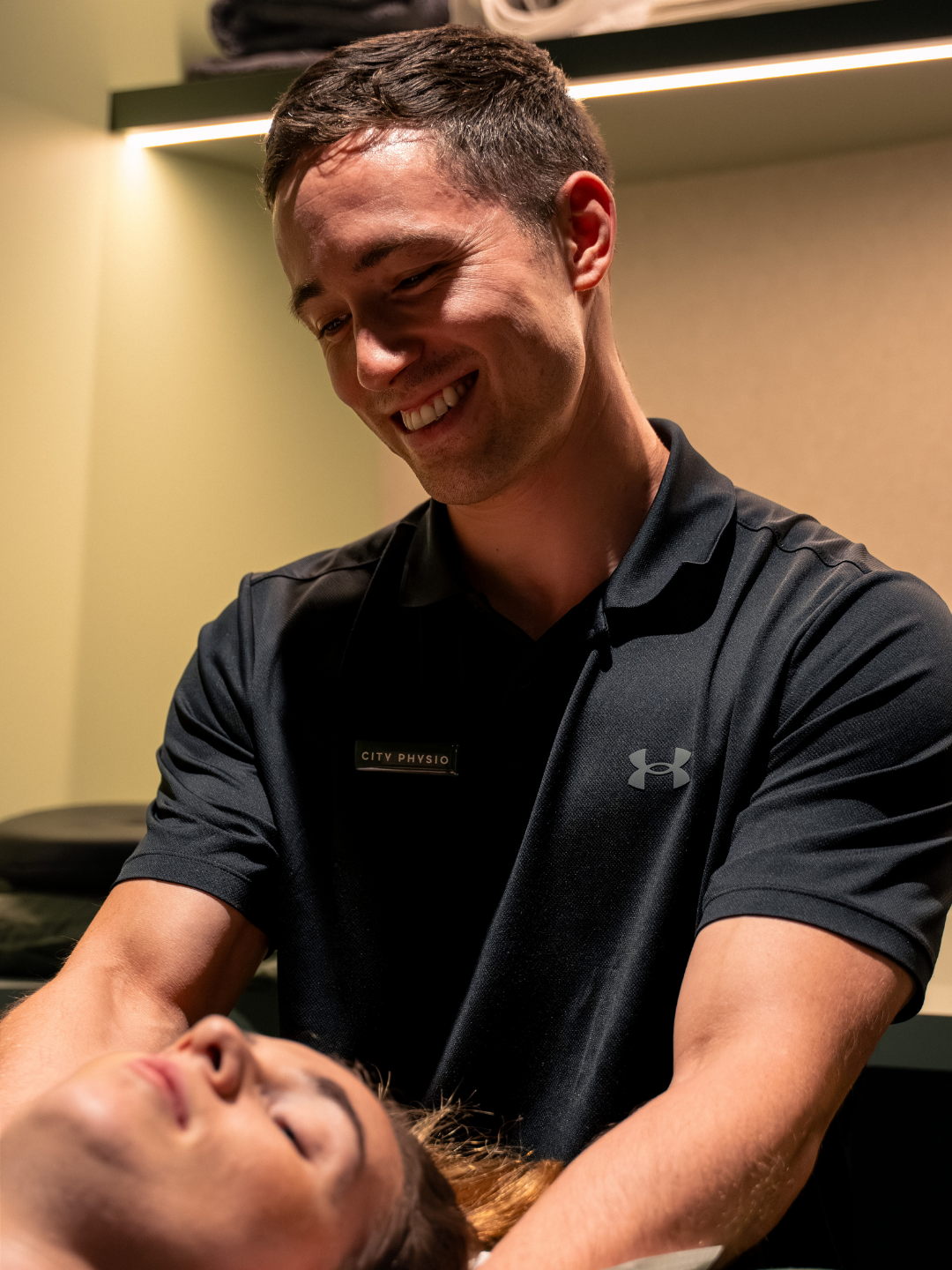
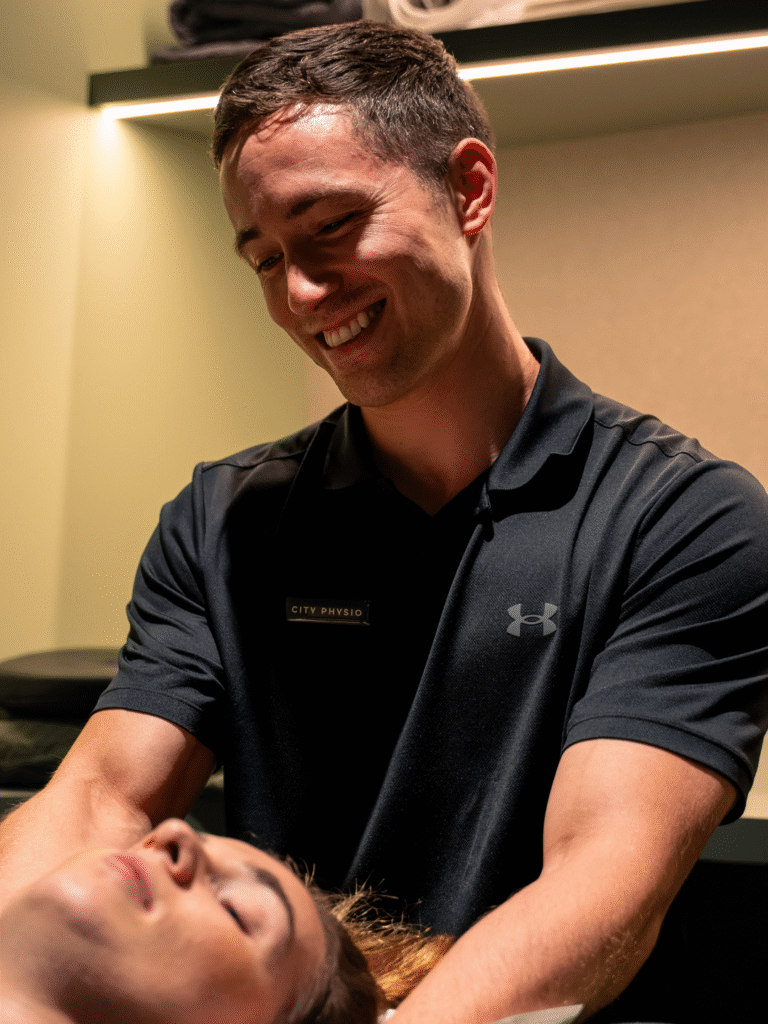
We look at how each level of the neck moves, how well the deep neck muscles switch on, how the upper back moves, and whether the nerves that refer into the head, shoulder and arm are sensitive. Treatment often combines:
- Joint mobilisation to the stiff levels of the neck that seem to be driving the stiffness and headaches
- Deep neck flexor retraining, progressed over time
- Upper back mobility, because a stiff upper back tends to push the neck forward
- Soft tissue work or dry needling as a support to the joint and exercise work, not the main event
- Practical advice for your actual week: travel, meetings and the habits doing the most damage
If Pilates suits you as a next step, your physio can hand you over to our Pilates instructors with notes.
A four-year history isn’t a life sentence. It’s often just four years of the wrong approach. Ed and Elizabeth see a lot of neck pain. More on neck pain and headache.
Related pages
Common questions
Why do I get neck pain at work even with a good desk set-up?
A good set-up reduces the load, but it doesn’t restore how well the deep neck muscles work or free up stiff joints. Both may need specific treatment.
Can stress cause neck pain?
Stress can raise muscle tension around the neck and shoulders and make the nervous system more sensitive, which may amplify existing neck problems. That’s why a neck that’s fine in a quiet week can flare before a big presentation.
Why does my neck feel worse after flying?
Long periods sitting with the neck bent or turned, poor support and broken sleep all add up. Symptoms sometimes show up a day or more later, so people don’t always connect the two.
What are the deep neck flexors?
Small muscles at the front of the neck, including longus colli and longus capitis, that help hold the head steady. In ongoing neck pain they often don’t work as well as they should, and retraining them is a common part of rehab.
Want someone to look at it?
Book online or call 9223 1575.
City Physio & Pilates, Shop 10, Level 6, 25 Martin Place, Sydney NSW 2000
Monday to Thursday 7am to 6pm. Friday 8am to 5:30pm.
Search the blog
General information only. It isn’t a substitute for an assessment.