By the City Physio team
Short answer. Tennis elbow is an overload problem in the tendons on the outside of the elbow, often from desk work, gripping or racquet sports. Education and gradual loading exercise are a sensible first approach, alongside hands-on treatment and workplace changes. Pilates can complement physio later in rehab.
Tennis elbow (lateral epicondylalgia, which just means pain on the outside of the elbow) is an overuse problem in the tendons that attach to the outside of the elbow. We see it a lot, largely because of long hours at a desk and on laptops.
It most often involves the tendon of a forearm muscle called extensor carpi radialis brevis, which helps lift the wrist. It’s linked with racquet sports, but most people we see with it get it from typing, gripping tools, manual work, or carrying small children (or pets). More on tennis elbow.
What’s going on in the tendon
Tennis elbow usually isn’t a typical inflammatory injury. It’s more about the tendon being overloaded over time, with changes in its structure that reduce how much load it can handle. Repeated gripping, lifting, typing or tool use without enough recovery is a common pattern.
Common symptoms
- pain on the outside of the elbow, often a little way down the forearm from the bony point
- pain lifting or gripping, especially with the elbow straight
- a weaker grip: opening jars, shaking hands, lifting things
- pain lifting the wrist against resistance, like a tennis backhand
How physio may help
Research suggests education and progressive loading exercise are a sensible first approach for most people. Our approach may include:
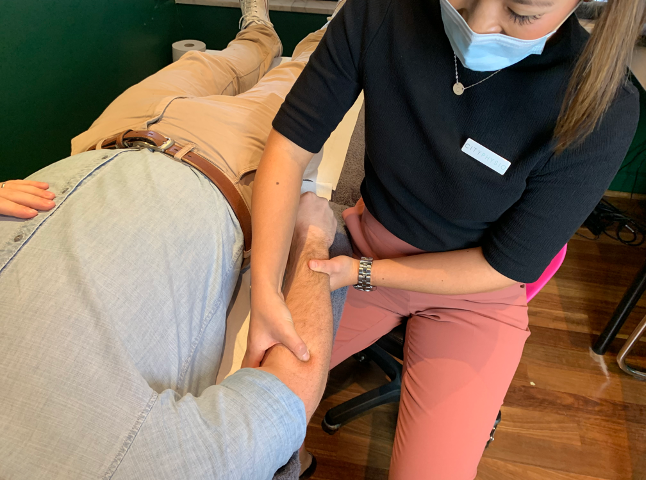
- Hands-on treatment around the elbow, wrist, neck and upper arm, such as soft tissue work, joint mobilisation, taping and dry needling.
- A graded exercise program that gradually builds the tendon’s capacity. Your physio will explain which type of exercise suits you.
- A whole-body look: shoulder weakness, a stiff upper back or poor shoulder blade control can add load to the elbow. Often the elbow is the innocent victim of a system that isn’t working well.
- Workplace changes: chair and desk height, an alternative keyboard or mouse, or desk aids to unload the elbow.
Where Pilates fits
Later in rehab, Pilates can complement physio. It can be good for building control of the shoulder blade, trunk and posture, which may affect how much load reaches the elbow, and for keeping up regular, progressive exercise. Exercises can be adjusted to unload the elbow (arms in straps, planks off the hands) or gradually reload it. Our Pilates classes are run by our instructors, not physios; your physio hands you over with notes when you’re ready.
When to get it looked at
If you have pain on the outside of the elbow with gripping or lifting, discomfort typing or using a mouse, weakness in the arm, or symptoms that keep coming back after activity, it’s worth an assessment. Ed, Christie and Matt see a lot of elbow problems.
Related pages
Common questions
Is tennis elbow inflammation?
Usually not in the typical sense. It’s more about the tendon being overloaded over time, which is why gradual loading exercise is a key part of treatment.
Can Pilates help tennis elbow?
Later in rehab, Pilates can be good for shoulder blade, trunk and posture control, and exercises can be adjusted to unload or gradually reload the elbow. Physio comes first.
Sources
Bisset LM, Vicenzino B. Physiotherapy management of lateral epicondylalgia. Journal of Physiotherapy 2015;61(4):174-181.
Want someone to look at it?
Book online or call 9223 1575.
City Physio & Pilates, Shop 10, Level 6, 25 Martin Place, Sydney NSW 2000
Monday to Thursday 7am to 6pm. Friday 8am to 5:30pm.
Search the blog
General information only. It isn’t a substitute for an assessment.