City Physio & Pilates | Expert Insights | Sports Injury & Rehabilitation
The Real Cost of a Poorly Rehabilitated Ankle Sprain — And Why “Walking It Off” Is Never the Answer
Why One Ankle Sprain, Badly Managed, Can Derail Your Performance for Years
You rolled your ankle. It hurt, you iced it, you limped around for a few days, and then you got back to it. Sound familiar? For most people, this is the entire “treatment plan” for one of the most common — and most consequential — injuries in sport and everyday life.
At City Physio & Pilates in Martin Place, Sydney CBD, we see the downstream effects of this approach every week: chronic instability, recurring sprains, compensatory injuries up the kinetic chain, and athletes and active people who’ve quietly accepted a lower level of performance as their new normal. None of it is inevitable. Almost all of it is preventable.
Here’s what actually happens when an ankle sprain doesn’t get the rehabilitation it deserves.
Why Ankle Sprains Are Deceptively Serious
An ankle sprain — most commonly a lateral sprain involving the anterior talofibular ligament (ATFL) and, in more severe cases, the calcaneofibular ligament (CFL) — is not simply a soft tissue bruise that heals with rest. It is a complex injury that simultaneously damages:
- Ligamentous structures responsible for passive joint stability
- Mechanoreceptors embedded within those ligaments — specialised sensory receptors that feed real-time position and movement information to the brain
- Neuromuscular control pathways that govern how quickly and accurately your muscles respond to unexpected ankle perturbation
- Intrinsic foot musculature that contributes to dynamic arch control and propulsion
Rest alone addresses none of these deficits. Swelling resolves. Pain fades. The underlying neuromuscular and proprioceptive damage remains — invisible, unaddressed, and waiting to cause problems.
1. Chronic Ankle Instability — A Preventable Epidemic
Chronic ankle instability (CAI) is defined as persistent subjective instability, recurrent sprains, and ongoing functional limitations more than 12 months after the initial injury. It is classified by the International Ankle Consortium as either mechanical instability (measurable laxity of the ankle ligaments) or functional instability (impaired neuromuscular control in the presence of structurally intact ligaments) — and most real-world cases involve elements of both.
The numbers are stark: approximately 20–40% of acute lateral ankle sprains progress to chronic ankle instability. Given that ankle sprains account for an estimated 16–40% of all sports injuries, and that millions of Australians participate in sport and recreational exercise, CAI represents an enormous and largely preventable burden of injury.
What drives this progression? When the ligaments are stretched or torn, the mechanoreceptors within them are damaged. These receptors are not passive structures — they are the sensory hardware your nervous system uses to detect ankle position, movement velocity, and surface instability in real time. Without targeted rehabilitation to retrain this system, the ankle remains neurologically vulnerable even after the ligament has healed. The joint feels unreliable. And it is.
Proper rehabilitation must address:
- Proprioception — your body’s sense of joint position in space
- Motor control — the precision and timing of muscle activation around the ankle
- Static and dynamic balance — single-leg stability under progressively challenging conditions
- Peroneal and intrinsic muscle strength — the active stabilisers that support the passive ligamentous system
- Reaction time — how quickly your muscles fire in response to unexpected perturbation
Miss any of these, and the ankle is not rehabilitated. It is simply rested.
2. The Recurrence Trap — Why Old Ankle Sprains Predict New Ones
One of the most robust findings in sports injury epidemiology is this: the single strongest predictor of a future ankle sprain is a previous ankle sprain. Athletes with a history of lateral ankle sprain are between two and five times more likely to sustain a subsequent sprain than those without injury history.
This is not bad luck. It is the direct consequence of incomplete rehabilitation creating a persistent neuromuscular deficit that makes the ankle vulnerable to re-injury in exactly the situations that demand it most: uneven ground, rapid changes of direction, landing from jumps, cutting movements in team sports.
The specific deficits that create this vulnerability include:
- Peroneal muscle weakness — the peroneus longus and brevis are the primary dynamic stabilisers on the lateral aspect of the ankle. After a sprain, these muscles demonstrate measurable strength deficits, delayed electromyographic onset latency (slower firing), and reduced endurance. Without targeted strengthening, they cannot adequately protect the ankle against inversion stress.
- Slowed balance reactions — postural control research consistently demonstrates that individuals with CAI show delayed and altered muscle activation patterns in response to sudden platform perturbations. The ankle simply cannot protect itself quickly enough.
- Reduced range of motion — dorsiflexion restriction following ankle sprain is well documented and, if not addressed, alters foot contact mechanics during running and landing, increasing stress on the lateral ankle structures.
- Intrinsic foot muscle weakness — the small muscles of the foot play a critical role in dynamic arch support and force distribution. Their atrophy following ankle injury is frequently overlooked, yet contributes significantly to altered movement mechanics throughout the lower limb.
Together, these deficits create what is sometimes called a “perfect storm” for re-injury — a situation where the ankle looks and feels fine in straight-line activity, but fails under the demands of real sport.
3. Long-Term Performance Limitations — The Hidden Cost Active People Don’t See
Athletes and active individuals tend to measure recovery by the return of pain-free walking. What they don’t measure — until it becomes obvious — is the gradual erosion of performance that follows an incomplete rehabilitation.
In competitive and recreational athletes, poorly rehabilitated ankle sprains are associated with:
- Reduced vertical jump height — reflecting impaired ankle plantarflexion power and altered stretch-shortening cycle mechanics
- Slower sprint acceleration — driven by reduced push-off force and compromised ankle stiffness at ground contact
- Decreased agility — particularly in tasks requiring rapid lateral direction changes
- Altered running mechanics — including reduced cadence, shorter stride length, and compensatory changes in hip and knee movement patterns
- Kinesiophobia — a fear of movement or re-injury that reduces training load, confidence, and willingness to push performance boundaries
For recreational exercisers and weekend warriors, the picture is equally significant:
- Reduced tolerance to running distance and intensity — often misattributed to fitness or age
- Difficulty with single-leg balance tasks — affecting yoga, Pilates, gym work, and everyday activities
- Early foot and ankle fatigue during prolonged standing or walking
- Overloading of the Achilles tendon and calf complex — as these structures compensate for a mechanically compromised ankle
Many of our patients at City Physio don’t initially connect these symptoms to an ankle sprain from two, five, or even ten years earlier. But the relationship is frequently there, and addressing the original deficit — even long after the injury — can produce remarkable improvements in comfort, capacity, and confidence.
4. Secondary Injuries — When the Ankle Problem Becomes a Body-Wide Problem
The ankle is the first joint to contact the ground during every step, jump, and landing. Its mechanics directly influence every structure above it. When the ankle is stiff, weak, or neuromuscularly compromised, the body redistributes load — and the structures that absorb that redistributed load are the ones that eventually fail.
Secondary injuries commonly associated with chronic ankle dysfunction include:
- Achilles tendinopathy — often driven by altered ankle mechanics increasing tensile load through the Achilles at ground contact
- Patellofemoral pain syndrome — knee tracking issues arising from altered lower limb alignment and hip compensations triggered by an unstable ankle
- Greater trochanteric pain syndrome and hip flexor overuse — as the hip musculature works harder to stabilise a compromised lower limb
- Lumbar spine and SI joint pain — from asymmetrical loading patterns across the pelvis
- Plantar fasciitis — associated with altered foot mechanics, intrinsic weakness, and changes in arch loading that frequently follow lateral ankle sprain
This is the kinetic chain principle in practice: dysfunction at the ankle doesn’t stay at the ankle. It travels up. By the time a patient presents with knee pain or hip pain, the original ankle injury is often long forgotten — but it remains the root cause.
What a High-Quality Ankle Rehabilitation Program Actually Looks Like
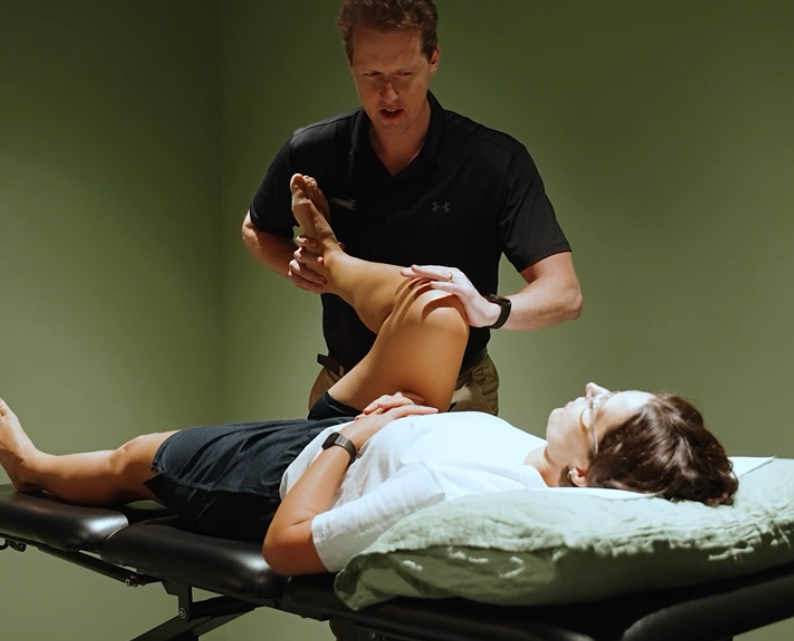
Generic advice to “rest, ice, and do some calf raises” is not a rehabilitation program. Evidence-based ankle rehabilitation is a progressive, staged process with clear criteria at each phase before advancing to the next. At City Physio, our ankle rehab programs are structured as follows:
Phase 1 — Acute Management and Mobility Restoration Swelling control, graded weight-bearing, restoration of pain-free range of motion — particularly dorsiflexion — and early neuromuscular activation to prevent muscle inhibition.
Phase 2 — Strength and Neuromuscular Control Targeted strengthening of the peroneal muscles, calf complex, and intrinsic foot musculature. Proprioceptive retraining beginning with static balance tasks and progressing to dynamic, unstable surfaces. Gait retraining where altered mechanics are identified.
Phase 3 — Functional and Sport-Specific Training Plyometric loading — single-leg hops, bounding, lateral jumps. Agility and change-of-direction training. Sport-specific drills at progressive speed and intensity. Confidence and movement variability work to address kinesiophobia.
Phase 4 — Return-to-Sport Testing and Clearance Objective testing before return to full training — including the single-leg hop test series, Y-Balance Test, and side-hop test — to confirm symmetry between limbs and readiness to tolerate sport-specific demands. We don’t clear patients based on time or pain alone. We clear them based on performance criteria.
Frequently Asked Questions: Ankle Sprain Rehabilitation in Sydney CBD
How long does it take to properly rehabilitate an ankle sprain? Grade I sprains (mild ligament stretching) typically require 2 to 4 weeks of structured rehabilitation. Grade II (partial tear) typically 4 to 8 weeks. Grade III (complete rupture) may require 8 to 12 weeks or longer, depending on surgical vs. conservative management. These timelines assume active rehabilitation — not passive rest. Return of pain-free walking is not the endpoint. Return of full neuromuscular function is.
I sprained my ankle months ago and it still feels unstable — is it too late to rehabilitate? It is never too late. We regularly treat chronic ankle instability in patients whose original injury was years or even decades ago. The neuromuscular system is highly adaptable, and targeted proprioceptive and strengthening work can produce significant improvements in stability and function even long after the initial injury.
Do I need a scan for an ankle sprain? Not always. The Ottawa Ankle Rules — a validated clinical decision tool — guide physiotherapists in determining when imaging is required to rule out fracture. Most lateral ankle sprains do not require X-ray or MRI. Your physiotherapist will assess this at your first appointment. If imaging is indicated, we will advise you accordingly.
Can I keep training with an ankle sprain? In many cases, modified training is possible and preferable to complete rest — particularly upper body work, swimming, or cycling that maintains fitness without loading the injured ankle. Your physiotherapist will advise what is safe based on the severity of your injury, your goals, and your timeline.
Should I be taping or bracing my ankle after a sprain? In the early stages, taping or bracing is appropriate to support the ankle during return to activity and provide external proprioceptive feedback. However, bracing is a management tool, not a substitute for rehabilitation. The goal is always to rebuild the internal stability that makes external support unnecessary over time.
City Physio & Pilates: Expert Ankle Rehabilitation in Sydney CBD
At City Physio & Pilates — located in Martin Place, in the heart of Sydney’s CBD — we treat ankle sprains with the same clinical rigour we apply to every injury: a thorough assessment, a precise diagnosis, a progressive evidence-based rehabilitation program, and objective criteria for return to sport or activity.
Whether you rolled your ankle last week or have been managing instability and recurrent sprains for years, we can help you rebuild a stable, strong, and fully functional ankle — and protect everything above it.
Don’t walk it off. Rehabilitate it properly. Book your ankle assessment at City Physio & Pilates, Martin Place, Sydney CBD