City Physio & Pilates | Low Back Pain | Martin Place, Sydney CBD
SIJ Dysfunction: The Low Back Pain Diagnosis That Keeps Getting Missed
You’ve had one-sided low back pain for three months. You’ve done the McKenzie exercises where you lean back again and again. You’ve been through the hip mobility routine your physio found on Instagram. You’ve bought a standing desk. The pain is still there — same side, same spot, same pattern. Getting dressed is awkward. Standing on one leg to put your shoe on is genuinely difficult. Some days are worse than others somehow? Walking up stairs feels uneven in a way you can’t quite describe.
There’s a reasonable chance nobody has properly assessed your sacroiliac joint.
What Is the SIJ and Why Does It Matter
The sacroiliac joint sits at the base of the spine where the sacrum — the triangular bone at the bottom of your vertebral column — meets the ilium on either side of the pelvis. You have two of them, one on each side, and under normal circumstances they move very little. That is by design.
The SIJ is not built for mobility. It is built for load transfer. Every time you walk, run, climb stairs, or shift your weight from one leg to the other, force travels from your spine down through the sacrum, across the SIJ, and into the pelvis and lower limb. The joint needs to be stable enough to transmit that force without shearing, while still allowing the small degree of movement required for normal walking mechanics.
That stability is achieved through two mechanisms, and understanding both is essential to understanding why SIJ dysfunction is so often subtle and so often missed.
Form closure refers to the bony architecture of the joint itself. The sacrum sits wedged between the two iliac bones, and the irregular, interlocking surfaces of the joint create a self-locking mechanism under load. Think of it like two rough stones pressed together — the surface texture itself resists sliding.
Force closure is the muscular contribution to joint stability. The deep muscles of the pelvis and trunk — the deep multifidus, the pelvic floor, the transversus abdominis, the gluteus maximus, the biceps femoris — apply compressive force across the SIJ to augment that bony locking mechanism. They function as a dynamic compression system. When form closure is compromised by ligament laxity, previous injury, or altered joint mechanics, the muscular system has to work harder to compensate.
Here is where the clinical picture gets interesting. When the SIJ starts moving in ways it should not — when small abnormal shear forces occur through the joint — the muscles that cross it become mistimed. The neuromuscular system controlling pelvic stability relies on a stable bony base to organise its firing patterns. When the structure underneath those muscles starts to move unpredictably, even slightly, the coordinated activation of the deep pelvic stabilisers breaks down. The timing goes off. Muscles that should fire before load is applied start firing reactively instead. The whole pelvic stability system begins compensating, and compensation patterns spread upward into the lumbar spine and downward into the hip.
This is why SIJ dysfunction rarely presents as simple pain over the joint. It presents as a pattern.
What SIJ Dysfunction Actually Looks Like
One-sided low back pain, typically localised in the area just below and medial to the posterior iliac spine — the dimple region of the lower back. It may refer into the buttock, the back of the thigh, and occasionally into the groin. It rarely radiates below the knee with the same sharp, neurological quality as a lumbar disc referral, though it can refer into the lower leg in some cases.
Patients commonly report difficulty with weight transfer. Getting out of a car is uncomfortable. Climbing stairs feels asymmetrical. Standing on the affected leg while the other one moves — putting on shoes, stepping into pants — provokes pain or instability. Rolling over in bed at night can be sharp and waking. Sustained single-leg loading in sport is often the point at which things break down completely.
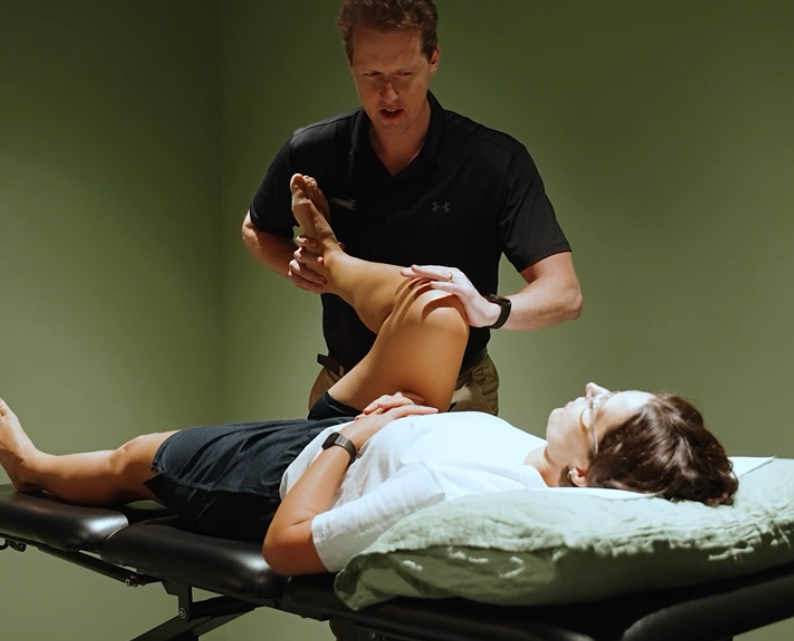
The clinical signs, when you know what to look for, are there. Subtle asymmetry in pelvic landmark position. Altered movement in the SIJ on active straight leg raise testing. A cluster of provocation tests — Posterior Shear, FABER, Distraction, Compression, Thigh Thrust — that, when three or more are positive, have good diagnostic accuracy for SIJ involvement. Standing and sitting Gillet tests assessing sacral and iliac movement. Palpation of the long dorsal sacroiliac ligament, which is exquisitely tender in active SIJ dysfunction and frequently overlooked entirely.
These are not complicated tests. They require good hands, an organised assessment framework, and the clinical conviction to include them. What they don’t require is a YouTube tutorial.
Why It Gets Missed
We see SIJ dysfunction missed multiple times per week. It comes through our door as a second opinion on persistent or recurrent low back pain that has not resolved despite months of treatment elsewhere. The pattern is consistent enough to be frustrating.
Part of the problem is that low back pain assessment in 2026 has become heavily influenced by a movement-focused, often social media-driven model that prioritises mobility drills, breathing patterns, and pelvic tilts over clinical examination. There is value in movement-based approaches. There is no value in applying them without first establishing an accurate diagnosis.
The deep pelvic tilt and breathwork prescription that helps a patient with lumbar segmental instability does nothing for SIJ dysfunction — and in some cases, loading an unstable pelvis with poorly sequenced exercise makes it worse. Targeting the wrong structure with the right exercise is still the wrong treatment.
A thorough low back assessment should include the lumbar spine, the hip, neurological screening, and the SIJ as a matter of routine. Not as an afterthought when the standard treatment has failed for three months. From the start.
Differentiating SIJ dysfunction from lumbar referral is particularly important and not always straightforward. A lumbar disc or facet joint can refer pain into the SIJ region and mimic the presentation. A true SIJ problem and a lumbar problem can also coexist. The clinical examination needs to be specific enough to distinguish between them, which requires both the right tests and the clinical experience to interpret them accurately. Getting this wrong sends treatment in the wrong direction from session one.
Back Pain Should Not Recur
This is perhaps the most important point in this entire article. Recurrent low back pain is not a normal part of life. It is a clinical sign that something was not properly identified or properly treated the first time.
If a low back pain episode has been correctly diagnosed, the driving factors identified, and a comprehensive rehabilitation plan completed, that episode should resolve and not come back. When the same patient returns six months later with the same presentation, the honest clinical question is not “what do we do differently this time” but “what did we miss last time.”
For a significant proportion of those patients, the answer is the pelvis.
How We Approach It
At City Physio & Pilates, we treat the pelvis as a whole. That means the SIJ, the lumbar spine, the hip, and the deep stabilising system around all three are assessed and addressed together, because they function together. Stabilising the SIJ in isolation without addressing the muscular control system around it produces incomplete results. Rehabilitating the deep pelvis without correcting aberrant mechanics at the joint level does the same.
Our assessment of persistent or recurrent low back pain includes a structured SIJ evaluation as standard. For complex presentations, we investigate the relationship between lumbar, pelvic, and hip mechanics before treatment begins — because treating the right structure with the right approach from session one is what produces outcomes that hold.
If you have been managing one-sided low back pain that keeps returning, or that has not responded to standard treatment, a second opinion at City Physio & Pilates is a sensible next step.
Related: Back Pain | Hip Pain | SIJ Physio | Groin Pain | Manual Therapy