

The Sydney CBD Professional’s Guide to Desk Pain
By City Physio & Pilates | 25 Martin Place, Sydney CBD
Neck locked up by Wednesday? Back screaming by Friday? You’re not broken… you’re just sitting too much. Here’s what’s actually happening, and how to fix it for good.
Why Desk Pain Is an Epidemic in Sydney’s CBD
If you work in banking, law, tech, consulting or government in Sydney’s CBD, your body is absorbing the cost of your career. Long hours, high-pressure deadlines, back-to-back screens, and the cursed combination of hot-desking and a laptop… none of it is doing your spine any favours!
“Desk pain” isn’t a formal diagnosis, but it’s one of the most common presentations we see at City Physio in Martin Place. It’s the umbrella term for musculoskeletal pain driven by prolonged sitting, poor ergonomics, and repetitive computer use. And in high-performance CBD workplaces, it’s almost universal.
The good news? It’s also almost entirely preventable – and highly treatable when you actually deal with it instead of just enduring it.
The Most Common Types of Desk Pain – and What’s Really Causing Them
1. Neck Pain and Tech Neck
Why it happens: When your screen is too low, too high, or sitting off to one side, your neck holds a sustained, loaded position for hours on end. This progressively overloads the cervical spine joints, the upper trapezius, the levator scapulae, and the deep neck stabilisers… the small muscles that are supposed to keep your head upright without effort!
The result is what’s commonly called “tech neck” – forward head posture driven by leaning toward screens or looking down at your phone during your commute. Every centimetre your head drifts forward adds roughly 4–5kg of effective load through your neck. Do that for 8 hours, five days a week, and you get the picture.
What you’ll feel:
- Neck stiffness that builds throughout the week
- Headaches that start at the base of the skull
- Pain and tightness between the shoulder blades
- Reduced ability to turn your head fully
- Pins and needles or numbness into the arms in more advanced cases
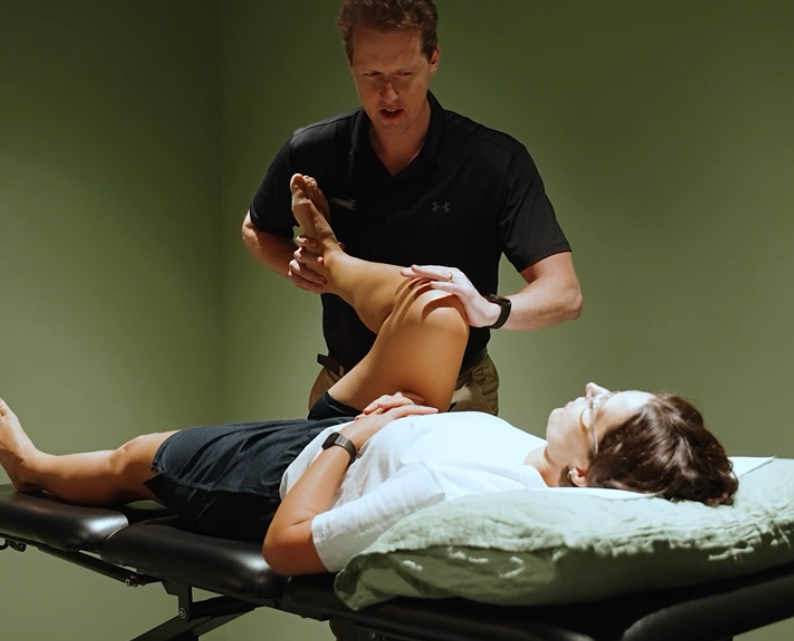
What we do about it at City Physio: We assess your full cervical spine mechanics, identify which joints and muscles are overloaded, and treat the cause rather than just the symptom. Treatment typically combines hands-on manual therapy to restore joint mobility, dry needling to release overactive muscles, and a targeted strengthening program for your deep neck flexors, the muscles responsible for keeping your head where it belongs. We’ll also review your workstation setup and give you specific, actionable changes, not generic advice you’ll ignore.
2. Lower Back Pain from Prolonged Sitting
Why it happens: Sitting is genuinely hard on the lower back, not because it’s inherently wrong, but because most people do it for too long, in poorly set up chairs, without moving. Sustained flexed posture increases pressure through the lumbar discs and progressively switches off the muscles that are supposed to stabilise your spine: the gluteals, the transversus abdominis, and the multifidus.
Hot-desking makes this worse. Chairs that don’t adjust properly, desks that are the wrong height, and the general chaos of not having a consistent workstation all add up to a lower back that’s perpetually on the back foot.
What you’ll feel:
- A dull, building ache in the lower back that worsens as the day goes on
- Pain or stiffness when you stand up after sitting
- Tight hip flexors and reduced hip mobility
- Sciatic-type symptoms – aching or shooting pain into the buttock or leg
What we do about it at City Physio: We’ll identify whether the primary driver is disc-related, joint-related, or muscular… because the treatment approach differs for each. A structured core stability and glute strengthening program is almost always part of the picture, alongside hip mobility work and lumbar joint mobilisation where indicated. We’ll also give you practical, realistic advice on movement breaks and position changes — not the standard “stand every 30 minutes” advice everyone ignores, but a plan that actually fits your working day.
3. Shoulder Pain and Upper Back Tension
Why it happens: Rounded shoulders, elevated shoulders during typing, poor keyboard positioning, and stress-related muscle guarding are the main culprits. The shoulder is a joint that depends entirely on the muscles around it for stability – and when posture is poor and those muscles are working in compromised positions all day, things start to break down.
What you’ll feel:
- Aching across the upper back and tops of the shoulders
- Pain or discomfort lifting your arm overhead
- Clicking, grinding, or weakness in the shoulder
- Tightness that’s hard to stretch out
What we do about it at City Physio: Shoulder blade (scapular) retraining is central to our approach here. If the shoulder blade isn’t moving properly, nothing upstream will work properly either. We combine soft tissue therapy, rotator cuff strengthening, and postural re-education, and where appropriate, integrate Pilates-based rehabilitation through our in-house studio to build the foundation of strength that keeps the problem from coming back.
4. Tennis Elbow from Mouse Use
Why it happens: Despite the name, tennis elbow (lateral epicondylitis) is one of the most common conditions we see in office workers. Specifically, it affects Sydney CBD professionals who spend 8-10 hours a day gripping a mouse and typing. Repetitive wrist extension and gripping irritates the tendons that attach at the outside of the elbow – and once it’s irritated, ordinary tasks become surprisingly painful.
What you’ll feel:
- Pain on the outside of the elbow
- Pain gripping a coffee cup, a door handle, or your mouse
- Weakness through the forearm and grip
- Aching that worsens toward the end of the week
What we do about it at City Physio: The evidence is clear that load management and progressive eccentric strengthening – not rest – is the gold standard for tendon recovery. We’ll build you a structured program, combine it with manual therapy and dry needling to manage the acute symptoms, and help you make the ergonomic adjustments (mouse position, keyboard setup, wrist posture) that stop it recurring.
5. Wrist Pain and Carpal Tunnel Symptoms
Repetitive typing and sustained poor wrist positioning can lead to wrist tendon irritation and, in more persistent cases, carpal tunnel syndrome symptoms – tingling or numbness in the thumb and first two fingers, reduced grip strength, and pain that wakes you at night.
Proper keyboard height, neutral wrist positioning, and targeted hand and forearm strengthening make a significant difference. These are treatable conditions that respond well to early physiotherapy – but only if you actually act on them rather than hoping they resolve on their own. They rarely do.
SEO search terms this addresses: carpal tunnel physiotherapy Sydney CBD, wrist pain desk work physio, hand and wrist pain office workers Sydney
Your Desk Setup: The Basics That Actually Matter
We don’t just treat pain… we help prevent it. If you’re a Sydney CBD professional spending 8+ hours at a desk, here’s the non-negotiable checklist:
- Screen at eye level – the top third of your screen should sit at eye height. Laptop users: get a stand and an external keyboard.
- Feet flat on the floor – not tucked under your chair (or butt!)
- Knees at roughly 90 degrees – with a finger-width gap between the edge of the seat and the back of your knee.
- Lumbar support engaged – your lower back should have contact with the chair back, not be floating in space.
- Keyboard and mouse close to your body – no reaching forward, shoulders relaxed and down.
- Screen directly in front of you – not off to the side.
If you’re in a hot-desk environment where you can’t control the chair and desk properly, the single most effective thing you can do is move more frequently. Not just standing… actually walking, stretching, and changing position throughout the day.
We offer comprehensive workplace ergonomic assessments tailored to your specific office setup – whether that’s a fixed CBD office, a hybrid arrangement, or a hot-desk environment.
Why You Shouldn’t Just Wait It Out
This is the part most Sydney CBD professionals get wrong. Desk pain rarely resolves on its own. What starts as mild end-of-day stiffness has a reliable tendency to become:
- Chronic, persistent pain that’s present even at rest
- Reduced work performance and concentration
- Disrupted sleep
- Compromised gym performance and weekend activity
- Recurrent flare-ups that get harder to manage each time
We know you’re busy. We know the diary is full. But early physiotherapy intervention costs you one lunchtime appointment and gets you back to full function quickly. Ignoring it costs you significantly more — in time, discomfort, and eventual treatment complexity.
Our physiotherapists at City Physio run back-to-back with active waiting lists precisely because Sydney CBD professionals have figured out that dealing with this properly is worth it.
Why City Physio at Martin Place?
We’ve been treating Sydney CBD professionals at 25 Martin Place for over 45 years. We understand the demands of high-performance CBD careers because we’ve spent decades treating people who live them… in finance, law, tech, consulting, government, and everything in between.
Our clinical team includes an APA Titled Sports & Exercise Physiotherapist, a Pain Management Masters specialist, and physios with deep expertise in musculoskeletal and occupational health. We treat the full picture — the injury, the contributing factors, and the plan to prevent it returning — not just the symptom in front of us.
We’re also one of the only physio practices in Martin Place with an integrated Pilates studio, which means for conditions requiring movement retraining and strength-based rehabilitation, you don’t have to go anywhere else.
Convenient for professionals across the CBD – we’re directly in the 25 Martin Place building, with easy access from Martin Place Station, Wynyard Station, and major bus routes.
Book a Desk Pain Assessment at City Physio Martin Place
If desk pain is affecting your work, your workouts, or your quality of life, the single best thing you can do is get it properly assessed.
 City Physio & Pilates Shop 10, Level 6, 25 Martin Place, Sydney CBD NSW 2000 (Rear of the food court — follow the signs)
 (02) 9223 1575
  hello@cityphysio.com.au
  cityphysio.com.au
Monday – Friday | 7:00am – 6:00pm