By the City Physio team
Short answer. The sacroiliac joint transfers load between the spine and the legs. When it isn’t doing that well, it can cause one-sided pain at the back of the pelvis that’s worse on stairs, standing on one leg and getting out of a car. It overlaps with back and hip pain, so a specific assessment matters.
You’ve been told it’s your lower back. Or your hip. Or possibly sciatica. You’ve had physio, maybe some massage, perhaps a course of anti-inflammatories. It improves a little, then comes back. It’s there when you walk, when you roll over in bed, when you stand up after a long meeting. One side of your pelvis feels heavier, or different, or just wrong in a way that’s hard to put into words.
If that sounds familiar, there’s a real chance the sacroiliac joint (SIJ) is part of it. We often see SIJ problems in people coming for a second opinion after months of treatment that hasn’t helped.
What the SIJ is
The SIJ is where the sacrum, the triangular bone at the base of the spine, meets the ilium, the large wing-shaped bone of the pelvis, on each side. Together with the pubic joint at the front, the two SIJs complete the ring of the pelvis.
The joint surfaces are irregular and interlock, which resists movement while allowing the small amount of motion needed for load transfer and shock absorption. It’s held by very strong ligaments at the back of the pelvis, and supported by muscles including the glutes, the hamstrings, the deep hip rotators, the pelvic floor, the multifidus and the abdominal wall. Those muscles press the joint together, which is often called force closure.
That matters for treatment: SIJ pain can come from the ligaments not holding as they should (after trauma, with hypermobility, or with pregnancy-related laxity), or from the muscles not supporting the joint well (weakness, poor timing, or switching off after pain or injury). Working out which helps decide what to do.
What the SIJ does
- Load transfer: every force between the legs and the spine passes through it, when you stand, walk, run, climb stairs, lift or land.
- Shock absorption: its small amount of movement helps soften impact.
- Keeping the pelvic ring stable when you’re on one leg, as you are with every step.
When that isn’t working well, the knock-on effects can show up in the lower back, hips and even knees.
What can cause SIJ pain
- Pregnancy and after the birth. Hormonal changes loosen the pelvic ligaments while load increases. Pelvic pain affects nearly one in five pregnant women, according to a Cochrane review. See our pregnancy back pain post.
- Trauma: a fall onto the buttock, a car accident or a heavy landing.
- Sustained lopsided loading: crossing your legs, leaning to one side, a heavy bag always on the same shoulder.
- Hypermobility, including hypermobile Ehlers-Danlos syndrome, where the joint relies more on muscles for support.
- Leg length difference, which can load one side more with every step.
- Training errors: sudden jumps in running, one-sided sports, or repeated high-impact loading.
What SIJ pain can look like
- one-sided pain at the back of the pelvis, just inside the bony point at the back of the pelvis; people often point to it with one finger
- pain standing on the affected leg, on stairs or stepping up a kerb
- pain getting up from a chair, rolling in bed, or getting in and out of the car
- pain into the buttock and sometimes the back of the thigh, usually without the nerve signs of sciatica
- a sense that the pelvis is twisted or “out”
- pain with long periods sitting or standing
It overlaps with lower back, hip and deep buttock problems, which is why diagnosis matters. A group of provocation tests, when several are positive, is reasonably accurate for SIJ involvement.
How we approach it
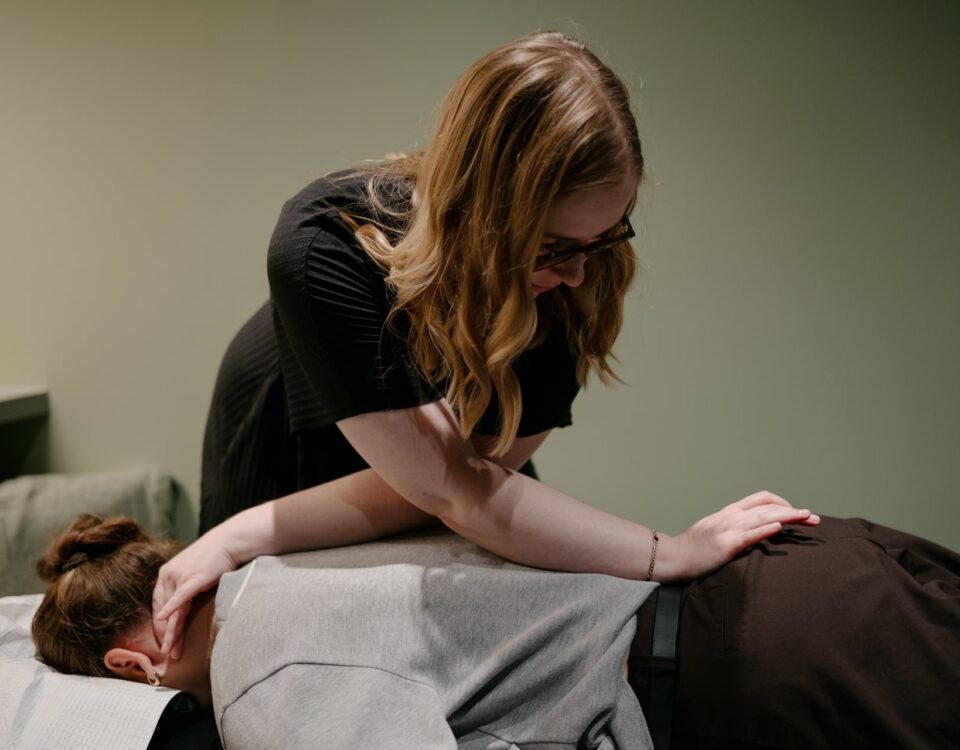
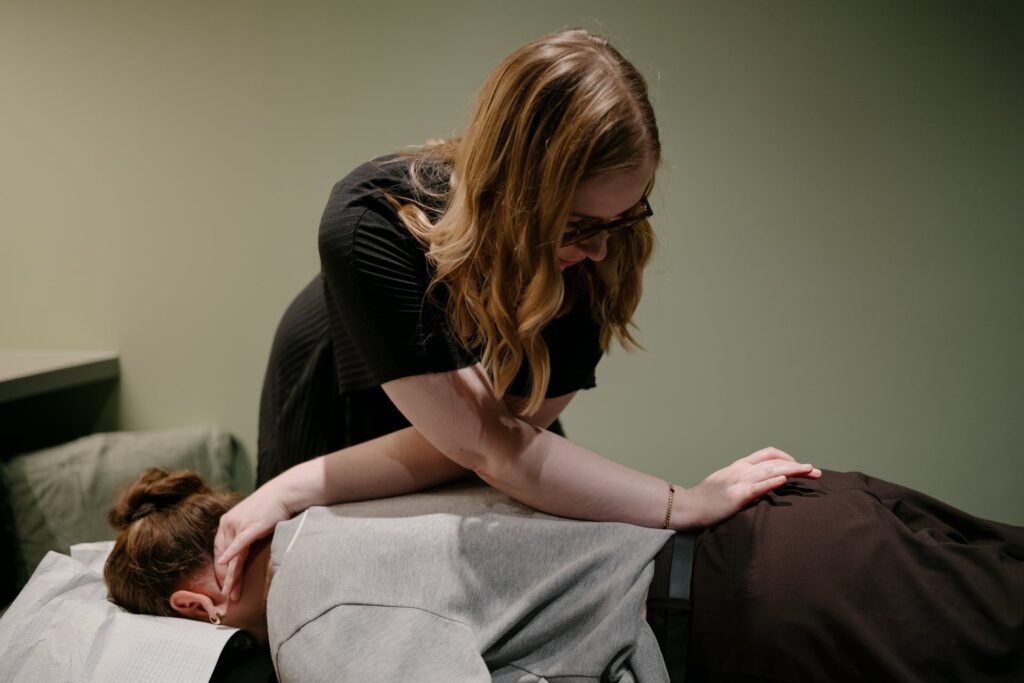
Assessment looks for subtle differences in how each side of the pelvis is positioned and moving, and how well load transfers through it, using tests such as the active straight leg raise. Treatment may include muscle energy techniques, which use your own gentle muscle contractions to influence how the joint sits and moves, followed by work to build the muscle control to hold it.
We also look beyond the joint: how the rib cage and breathing affect the deep trunk muscles, the glutes and deep hip rotators, and compensations through the hip, knee and upper back. We don’t do pelvic floor assessments; where the pelvic floor seems involved, we work with women’s health and pelvic health physios.
Elizabeth is certified in the Integrated Systems Model (ISM), as taught by Diane Lee, and has an eye for pain that keeps coming back. If Pilates suits you as a next step, your physio can hand you over to our Pilates instructors with notes. More on back pain and second opinions.
Related pages
Common questions
How do I know if it’s my SIJ and not my back or hip?
SIJ pain usually sits low at the back of the pelvis and is brought on by single-leg tasks and getting up or turning over, rather than bending and arching. A group of specific tests, done by a physio, helps tell them apart.
Why does my SIJ keep ‘going out’?
A common reason is that the joint has been treated without enough work afterwards on the muscle control that holds it. Treatment usually needs both.
Do I need a scan for SIJ pain?
It depends. X-rays and MRI don’t show most problems with how the joint is moving. Imaging is more useful for ruling out inflammatory conditions or injury after trauma.
Sources
Laslett M et al. Diagnosis of sacroiliac joint pain: validity of individual provocation tests and composites of tests. Manual Therapy 2005;10(3):207-218.
Liddle SD, Pennick V. Interventions for preventing and treating low-back and pelvic pain during pregnancy. Cochrane Database of Systematic Reviews 2015;(9):CD001139.
Want someone to look at it?
Book online or call 9223 1575.
City Physio & Pilates, Shop 10, Level 6, 25 Martin Place, Sydney NSW 2000
Monday to Thursday 7am to 6pm. Friday 8am to 5:30pm.
Search the blog
General information only. It isn’t a substitute for an assessment.